Smart Android And Trik-Commenting on Andorid indeed never endless, because smart devices this one is often updated every certain amount of time. So that the market can always be garapnya menerinya with pleasure. And it is not denied if this device has become the lifestyle of each society. To not wonder if the 6th business information and many are turning to mobail smartphone. With Android which thoroughly dominated the mobile industry, choosing the best Android smartphone is almost identical to choose the best smartphone, period. But while Android phones have few real opponents on other platforms, internal competition is intense.
Introduction
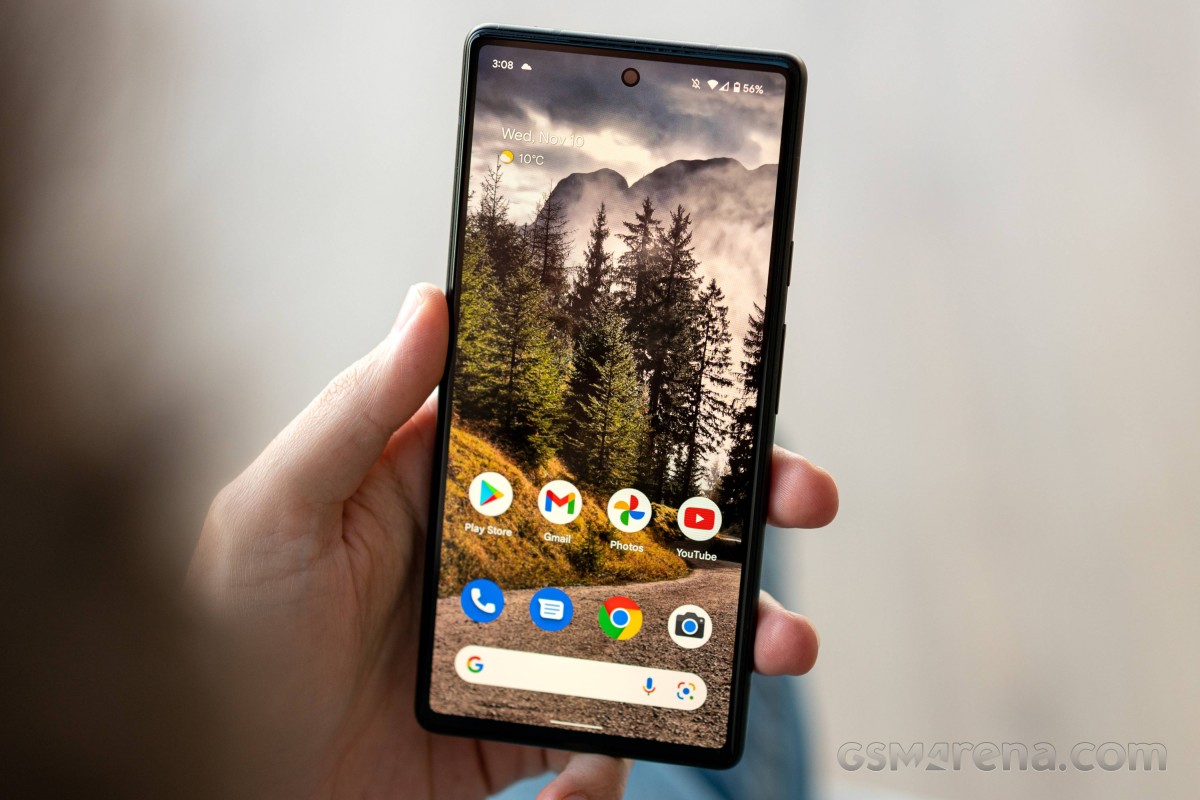
After a brief hiatus in 2020, Google returned this year to the flagship smartphone scene with the Pixel 6 Pro. But the company is no stranger to sorta flagships, and the Pixel 6 non-Pro is kinda just that if you'll forgive our overuse of Google's own terminology.
In true not-quite-there fashion, the Pixel 6 omits the telephoto camera - that one is reserved for the Pro. It does get to keep the other two in that black camera strip that makes this year's Google phones so unlike any other. Similarly, you won't be getting the ultrawide-ish 11MP selfie unit of the Pro, but the non-Pro's sorta wide (last time) selfie camera is good enough.
Other concessions await in the display section. Instead of the 120Hz QHD panel of the Pro, the Pixel 6 makes do with a 90Hz FullHD screen. It's not as big either, but at 6.4 inches, the non-Pro is not a small Pixel like we had with the earlier generations - we did like those, sigh.
That pretty much exhausts the list of principal differences between the two Pixel flavors. You do get the same brand-new in-house designed Tensor chip that enables all sorts of on-device machine learning cleverness, and while the 8GB of RAM here aren't quite the Pro's 12GB, they sure sound like plenty. Along those lines is the smaller battery and slightly slower charging.
Google Pixel 6 specs at a glance:
- Body: 158.6x74.8x8.9mm, 207g; Glass front (Gorilla Glass Victus), glass back (Gorilla Glass 6), aluminum frame; IP68 dust/water resistant (up to 1.5m for 30 mins).
- Display: 6.40" AMOLED, 90Hz, HDR10+, 1080x2400px resolution, 20:9 aspect ratio, 411ppi; Always-on display.
- Chipset: Google Tensor (5 nm): Octa-core (2x2.80 GHz Cortex-X1 & 2x2.25 GHz Cortex-A76 & 4x1.80 GHz Cortex-A55); Mali-G78 MP20.
- Memory: 128GB 8GB RAM, 256GB 8GB RAM; UFS 3.1.
- OS/Software: Android 12.
- Rear camera: Wide (main): 50 MP, f/1.9, 25mm, 1/1.31", 1.2µm, omnidirectional PDAF, Laser AF, OIS; Ultra wide angle: 12 MP, f/2.2, 17mm, 114˚, 1.25µm.
- Front camera: 8 MP, f/2.0, 24mm (wide), 1.12µm.
- Video capture: Rear camera: 4K@30/60fps, 1080p@30/60/120/240fps; gyro-EIS, OIS; Front camera: 1080p@30fps.
- Battery: 4614mAh; Fast charging, 50% in 30 min (advertised), Fast wireless charging 21W, Reverse wireless charging, USB Power Delivery 3.0.
- Misc: Fingerprint reader (under display, optical); NFC.
Google Pixel 6 unboxing
Google joins in on the no-charger trend this time around, and the Pixel 6 arrives in a half-height box as has become the norm at the high-end market segment. The lid has a print of the actual phone on top, and the sides are color-matched as well - hence boring black on our review unit.
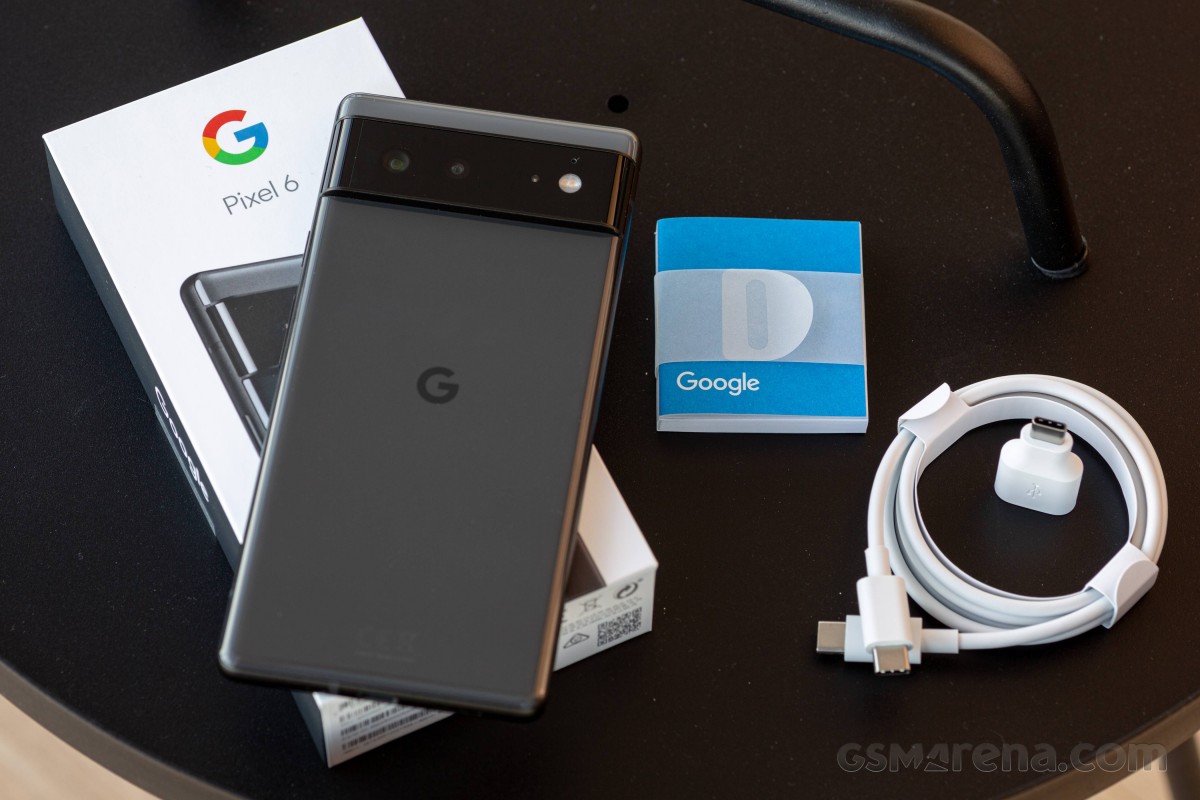
In terms of accessories, inside the box, you'll find a USB-C cable and USB-A-to-C adapter, should you choose to plug in a USB stick or maybe transfer data from an old microUSB-equipped phone using its own cable.
Design, build quality, handling
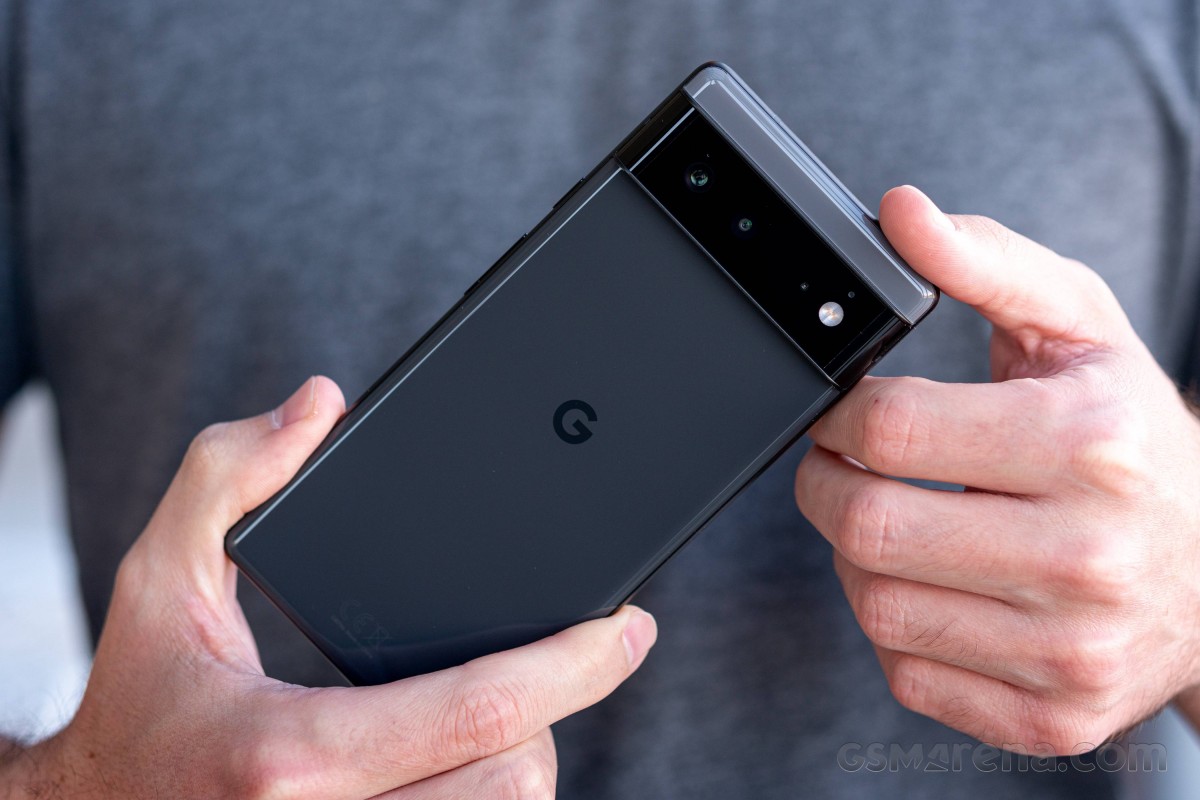
You can call the Pixel 6's design anything, but 'generic' would just be wrong. In a time of countless nondescript rectangles, Google's rectangle may be the same on the front, but it's like no other when viewed from the back.
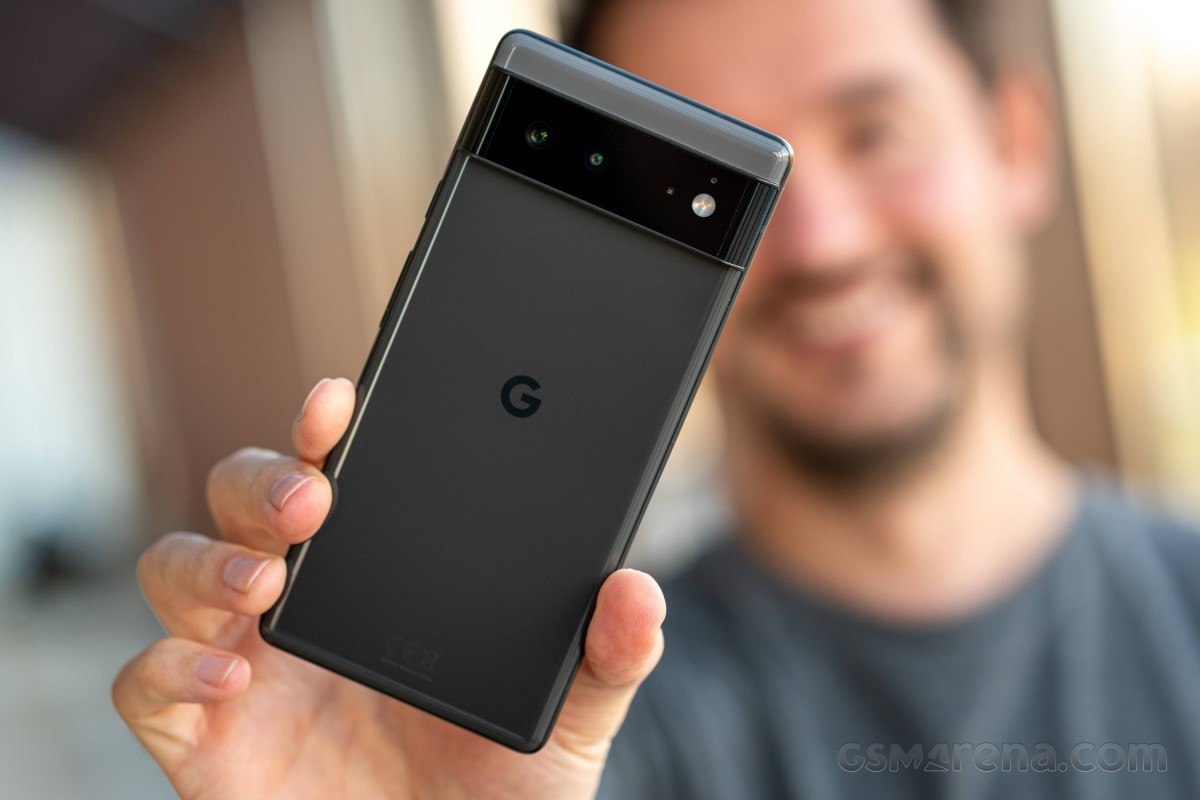
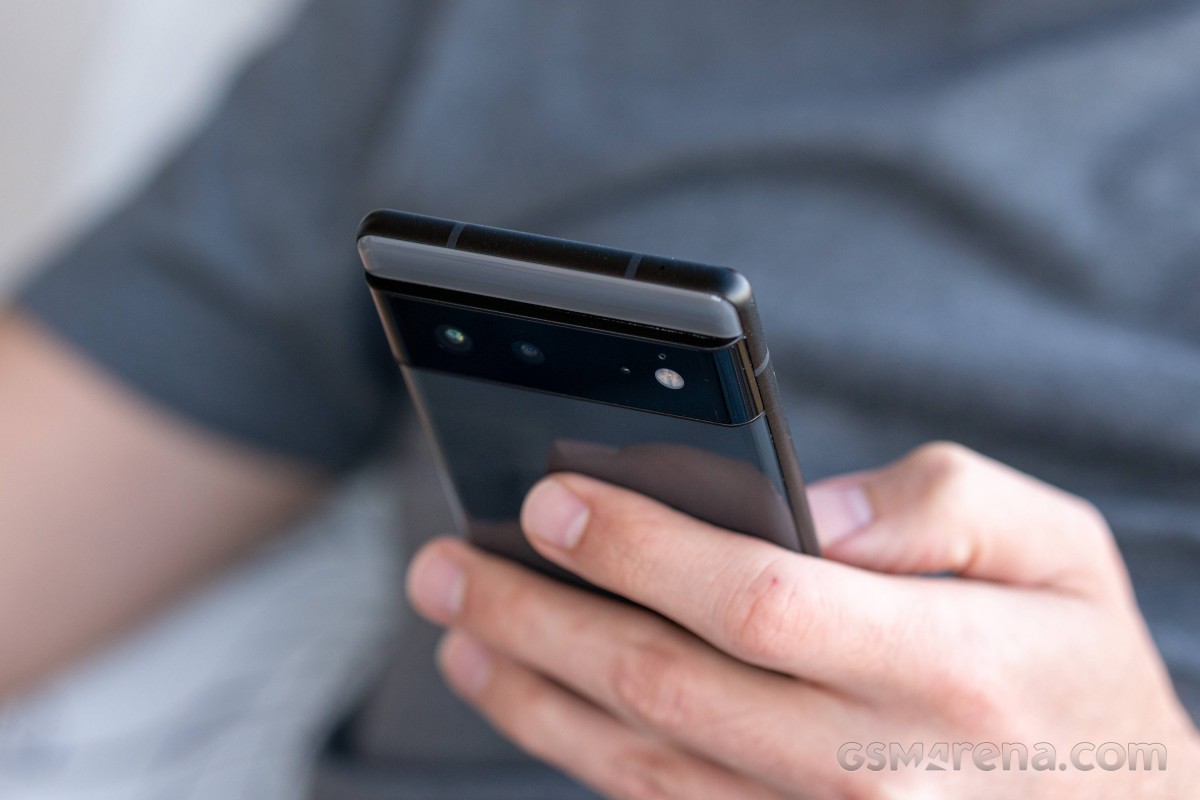
The camera strip is the defining feature of the 6s' design. The Pixel 6 non-Pro here has the same visor-looking camera assembly as the Pro, despite being one telephoto module short. Spanning the entire width of the phone, the strip affords ample room for the two cameras, an LED flash, laser AF emitter/receiver, a 'spectral and flicker sensor', and a mic.
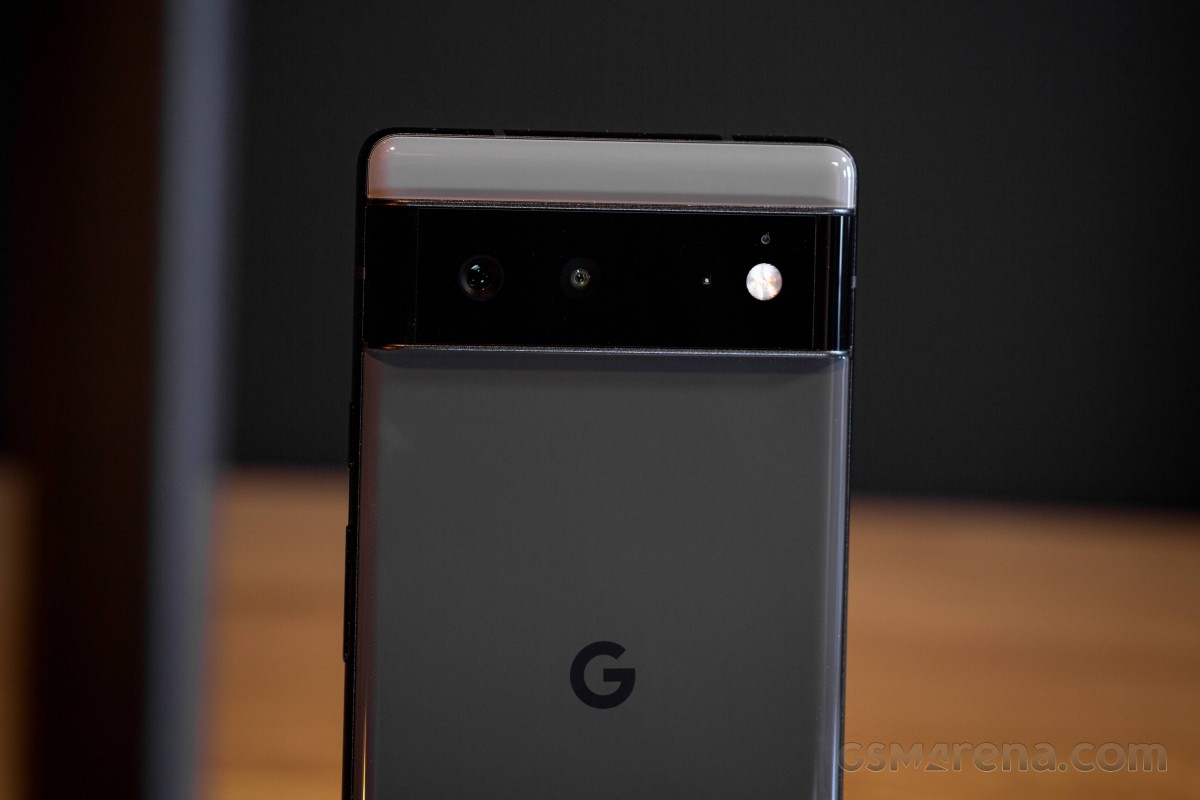
The visor sticks out by nearly 3mm from the back, but since it goes all the way from one end to the other, it doesn't cause any wobble. That's the good bit. Less so is the tendency for lint and dust to accumulate along the edges of the camera strip.
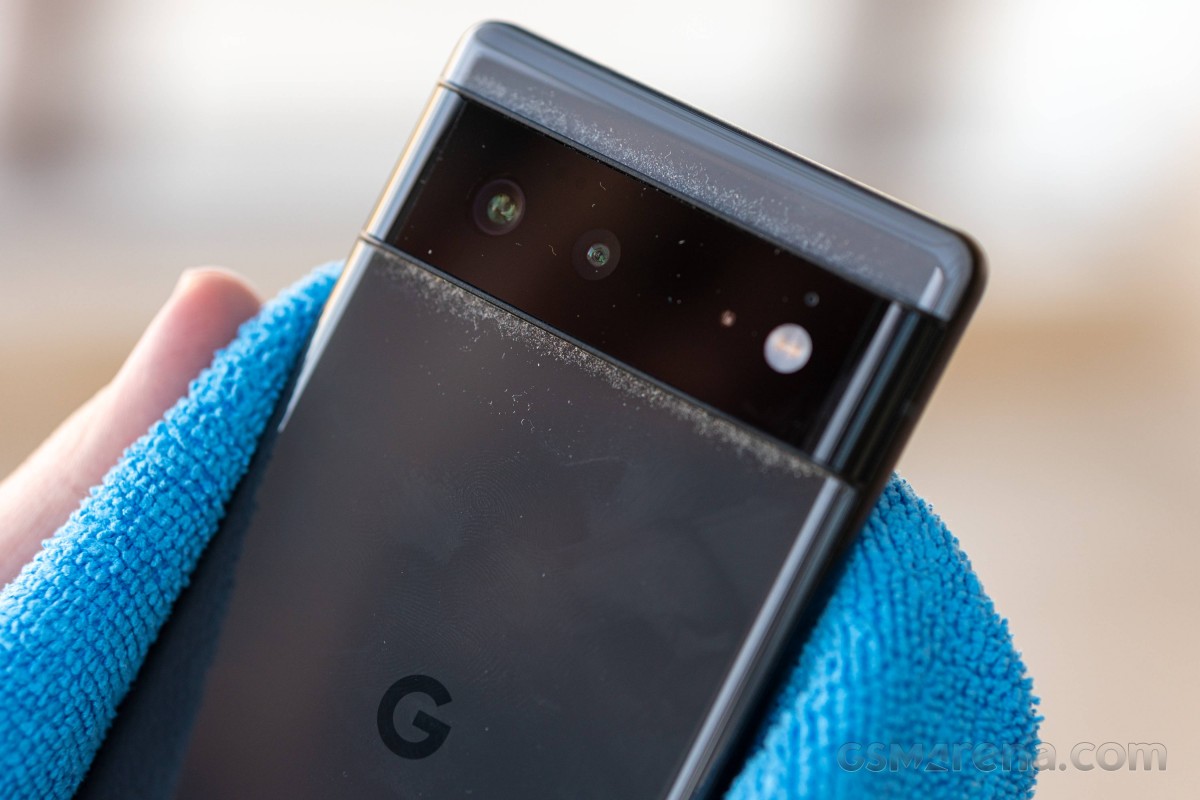 The camera 'visor' is a lint magnet
The Gorilla Glass 6 back pucks up its share of fingerprints, no glossy glass panel is immune to those. It's about as grippy as the rest of them, too - better than a frosted panel, not great in the grand scheme of things. A unique feature of the Pixel 6s is that you can, in a way, hold them by the camera assembly or prop them with an index finger to lift some of the weight of your pinkie.
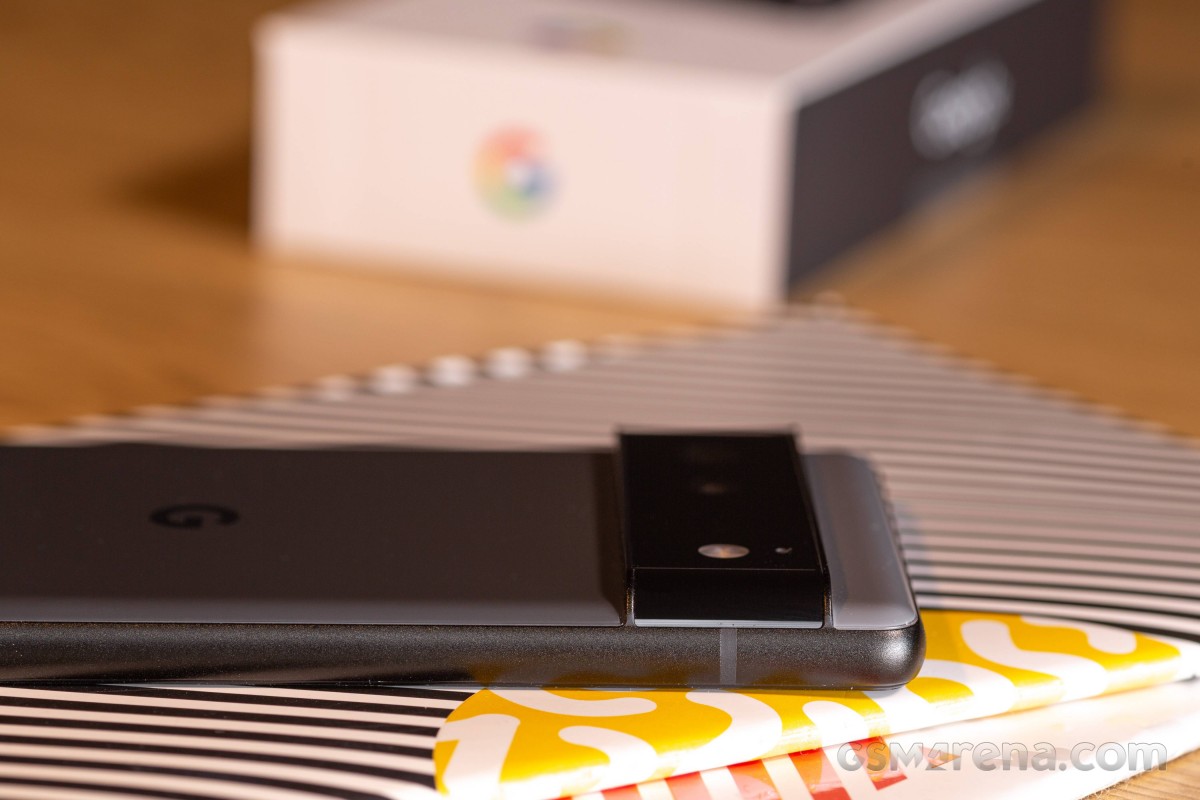
Each of the three color options comes with a two-tone look, the portion above the camera island getting a different hue than the large panel below. Our Stormy Black review unit is, in fact, primarily dark gray with a lighter gray accent band on top.
The Kinda Coral variant only made a brief appearance at the office, and 'kinda' is warranted - only the accent strip is coral in the way we understand colors, while the rest is a much paler hue. Sorta Seafoam is the one we haven't seen, the spiritual successor to the Sorta Sage Pixel 5.
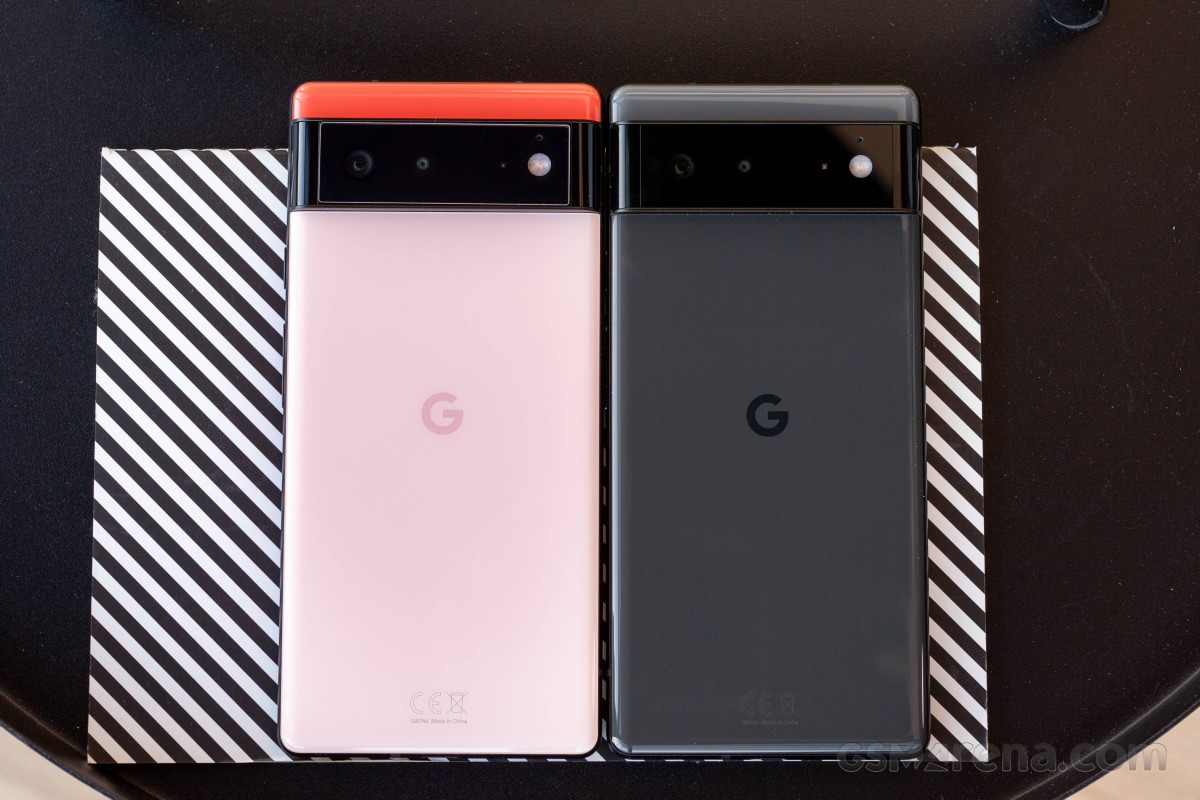
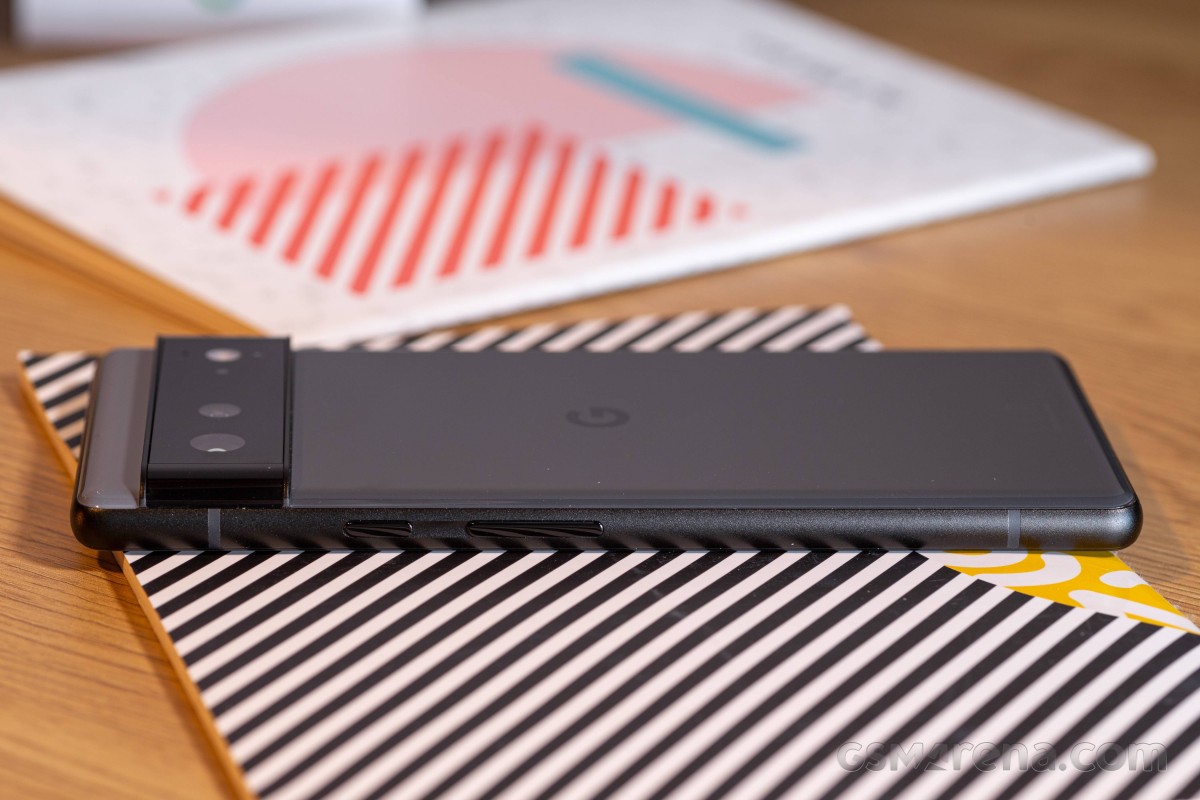
Speaking of design accents, gone is the colorful power button; it's black this time around regardless of color option. That goes for the frame, too, the matte aluminum coming in black only. It is matte, too, as opposed to the glossy finish of the Pixel 6 Pro's frame, and we dare say this one is less grippy.
The power button is on the right side of the phone, above the volume rocker - a Pixel oddity that takes some getting used to. If you're coming from an older Pixel, you should be right at home, but if this is your first one, prepare for involuntary volume adjustments or taking random photos when trying to put the phone to sleep.
On the opposite side of the phone, about a quarter up, is the SIM card tray. It'll only accept a single nano-SIM with a provision for eSIM if you want to have two. There's no microSD support, nor has there ever been. Unlike other phones that almost make it a point to advertise, the gasket around the card tray is made black and inconspicuous here but fret not - the Pixel 6 has an IP68 rating for dust and water resistance.
The bottom hosts the USB-C port, which is lined on the inside with plastic. Two identical-looking cutouts in the frame make way for the primary speaker and the primary mic. Another mic pinhole can be found up top.
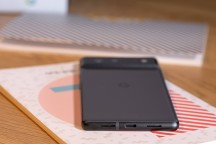

SIM tray on the left • USB-C port, speaker, and mic on the bottom • Another mic up top
Over on the display side, we're seeing that flat AMOLED display surrounded by a bezel with some... presence. We wouldn't go so far as to call the black borders thick, but they're certainly not minimal either. The glass itself does gently curve towards the outer edges, making for a more premium-feeling swiping action.
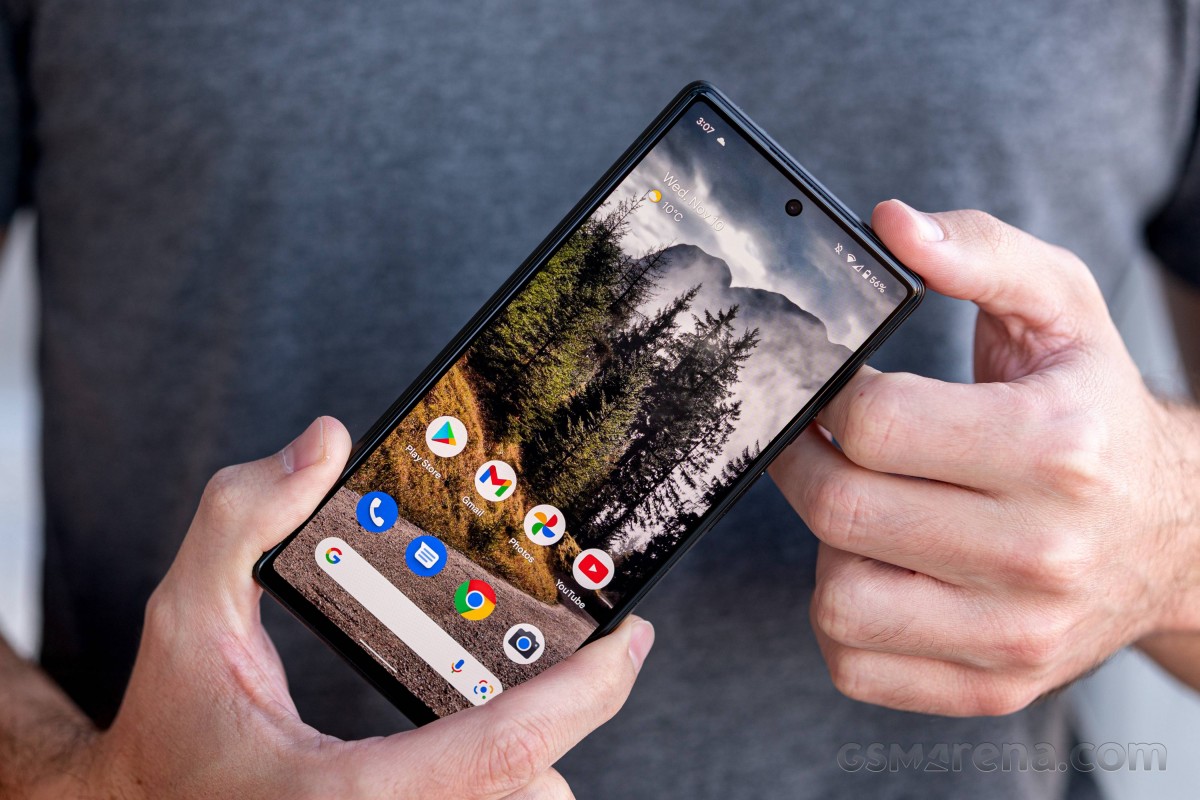
In any case, the Pixel 6 Pro does have a more 'expensive' look, a sentiment coming from both the curved-edge screen (which, we know, has vocal haters) and the thinner borders.
The Pixel 6 has a punch hole selfie camera in the middle of the top edge of the display. Above it is a long thin slit that has the earpiece blasting from the left end while the rest is seemingly just for symmetry.
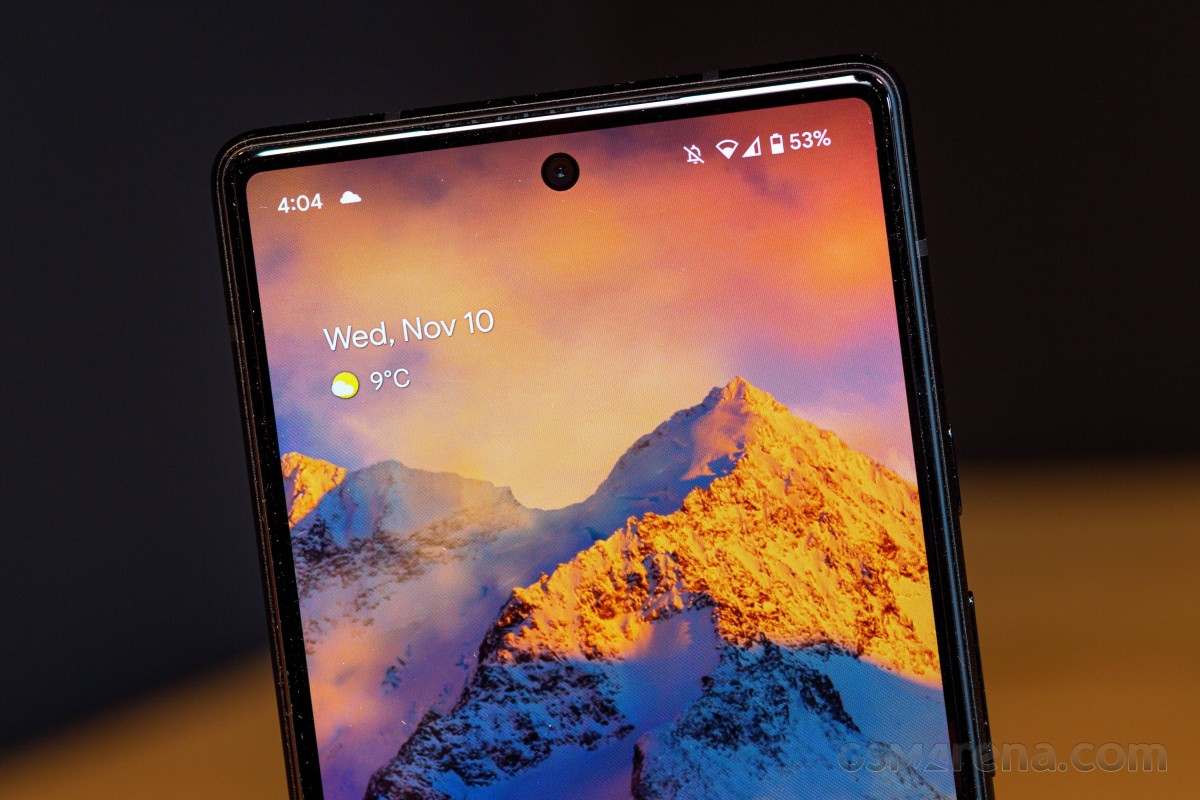
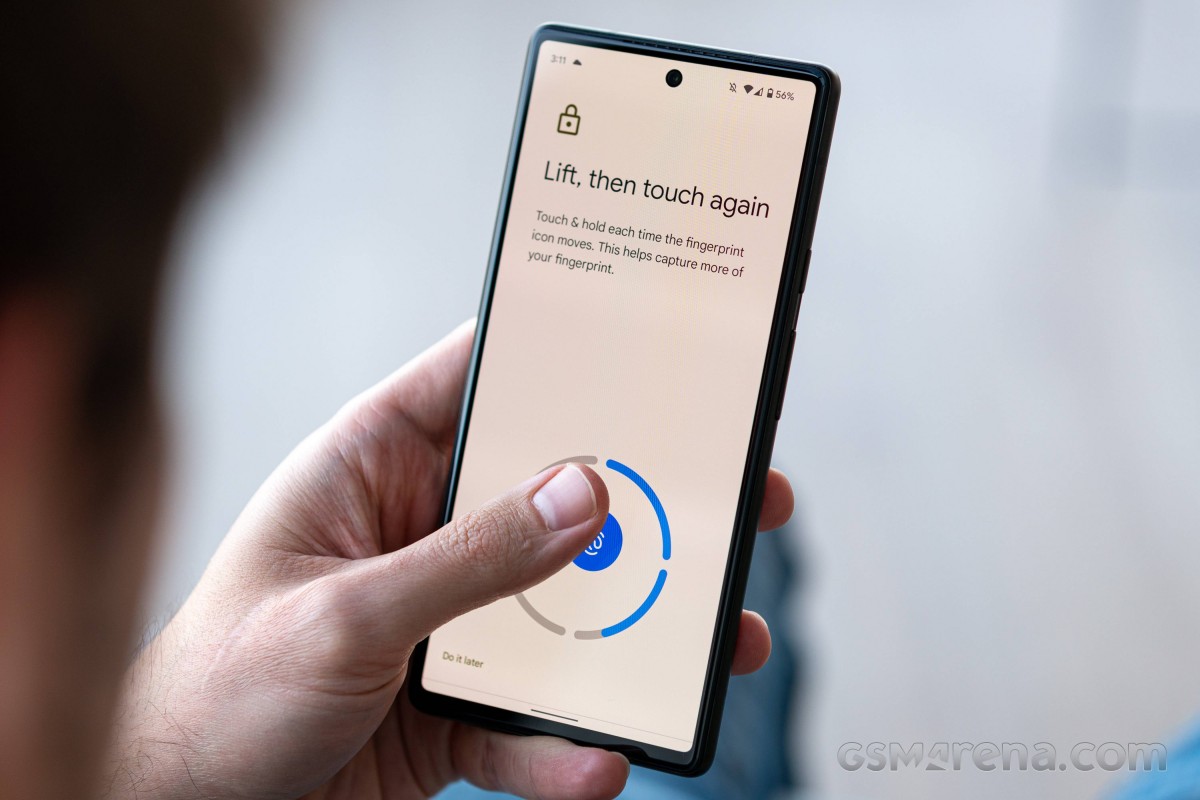
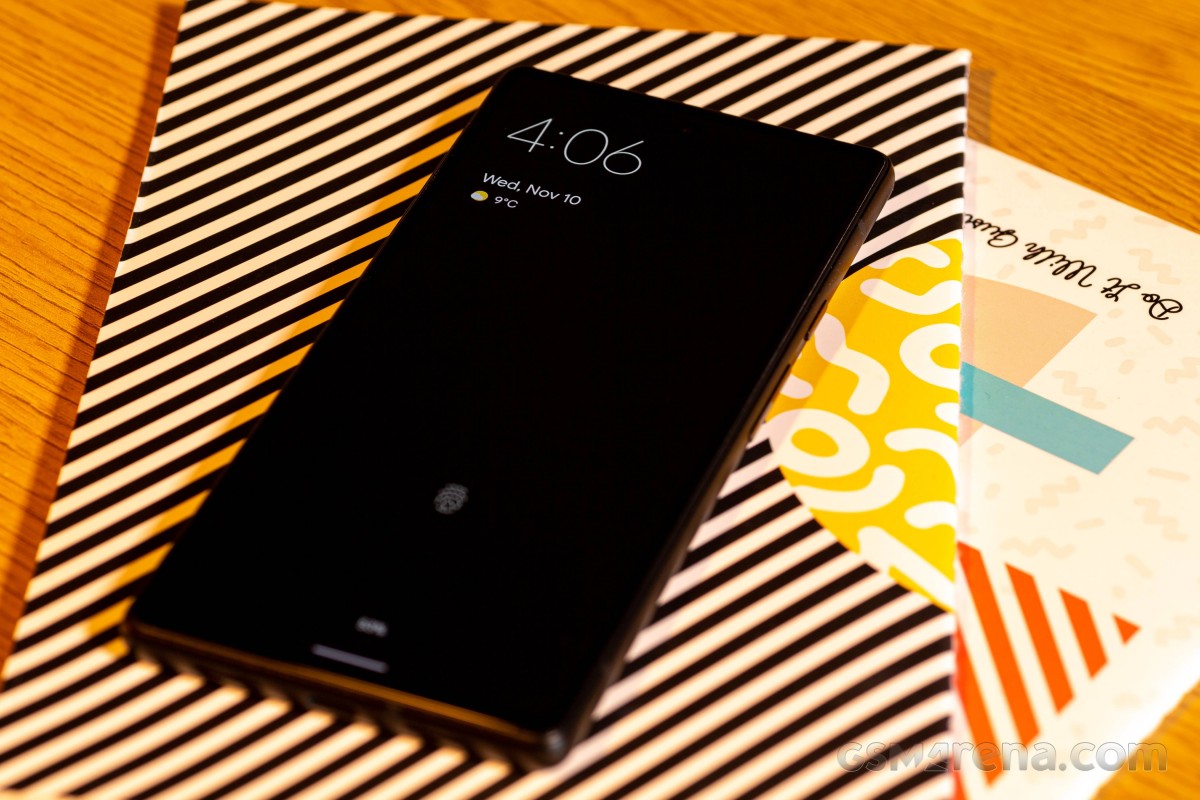
An under-display fingerprint reader of the optical variety is placed a little over a quarter of the way up the central axis of the screen. We usually complain about FPRs being too low; this one is a notch too high, but finding it becomes second nature soon enough, and it's not like it requires stretching.
It's not the quickest around and won't work with a brief tap - it takes a marginally more deliberate press to unlock, but we wouldn't say it ever kept us waiting.
The Pixel 6 measures 158.6x74.8x8.9mm and that's just 5mm shorter than the Pro and a single mil narrower, both phones having the same thickness. The non-Pro is then no mini Pixel no matter how you try to spin it. The 207g shown on the scales make no promises for pocket-friendliness, either - that's more than the Galaxy S21+ or the iPhone 13 Pro. The extra 3g on the Pro are immaterial at this point.
6.4-inch AMOLED is good... enough
The Pixel 6 comes with a few notable downgrades in the display department compared to the Pro, and we're not talking about the flat edges - that might actually be an advantage in some people's eyes.
No, we're talking about the 90Hz refresh rate vs. the 120Hz on the big Pixel and the 1080p resolution where the Pro goes all the way up to 1440p.
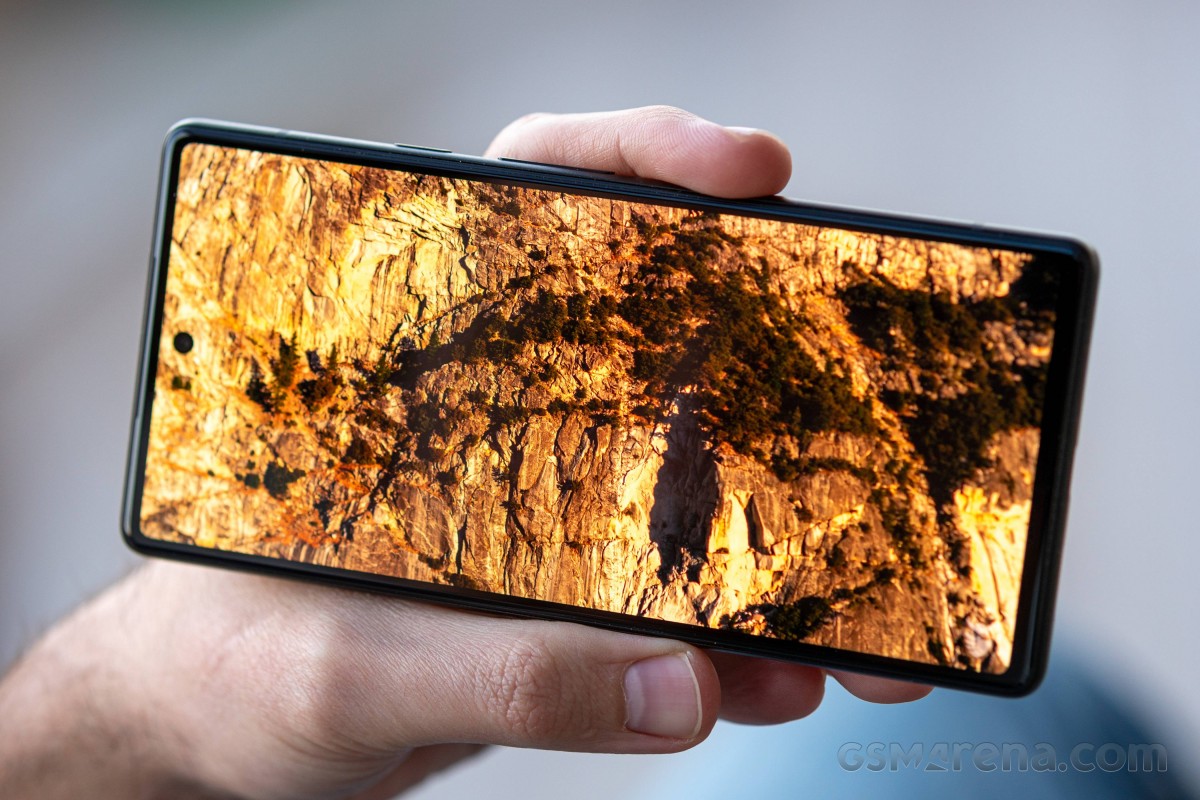
It's still an AMOLED, the Pixel 6's display, and at 6.4 inches in diagonal, it's anything but small - there's no small Pixel this time around, as already established. The 1080x2400px resolution works out to 411ppi, a 100ppi short of the Pro's density, but perfectly acceptable.
We measured marginally lower results for brightness on the Pixel 6 than what we got out of the Pro, but both the manually attainable 477nits and the ambient light mandated 846nits are very good results. Competitors like the iPhone 13 or the Galaxy S21 are in the same ballpark while the top-end iPhone Pros and the Galaxy Ultras go beyond the 1000-nit threshold.
| Display test | 100% brightness | ||
| Black, |
White, |
||
| 0 | 477 | ∞ | |
| 0 | 846 | ∞ | |
| 0 | 497 | ∞ | |
| 0 | 860 | ∞ | |
| 0 | 416 | ∞ | |
| 0 | 856 | ∞ | |
| 0 | 802 | ∞ | |
| 0 | 440 | ∞ | |
| 0 | 800 | ∞ | |
| 0 | 498 | ∞ | |
| 0 | 926 | ∞ | |
| 0 | 450 | ∞ | |
| 0 | 821 | ∞ | |
The Pixel 6 comes with a three-position selector for color reproduction and no options for further tweaking. The out-of-the-box Adaptive preset covers a wide color gamut and does so with okay accuracy - average dE2000 was 3.1 in our tests with DCI-P3 color swatches, and the white point was accurate, unlike the bulk of blue-leaning screens on the market. The Boosted mode was actually marginally closer to the DCI-P3 targets with an average dE2000 of 2.9. Natural mode is best suited for sRGB content and returned an average dE2000 of 1.9 - good enough.
The Pixel 6's display is HDR10+ compliant. We got HDR streams in YouTube, Netflix and Amazon Prime Video, as expected.
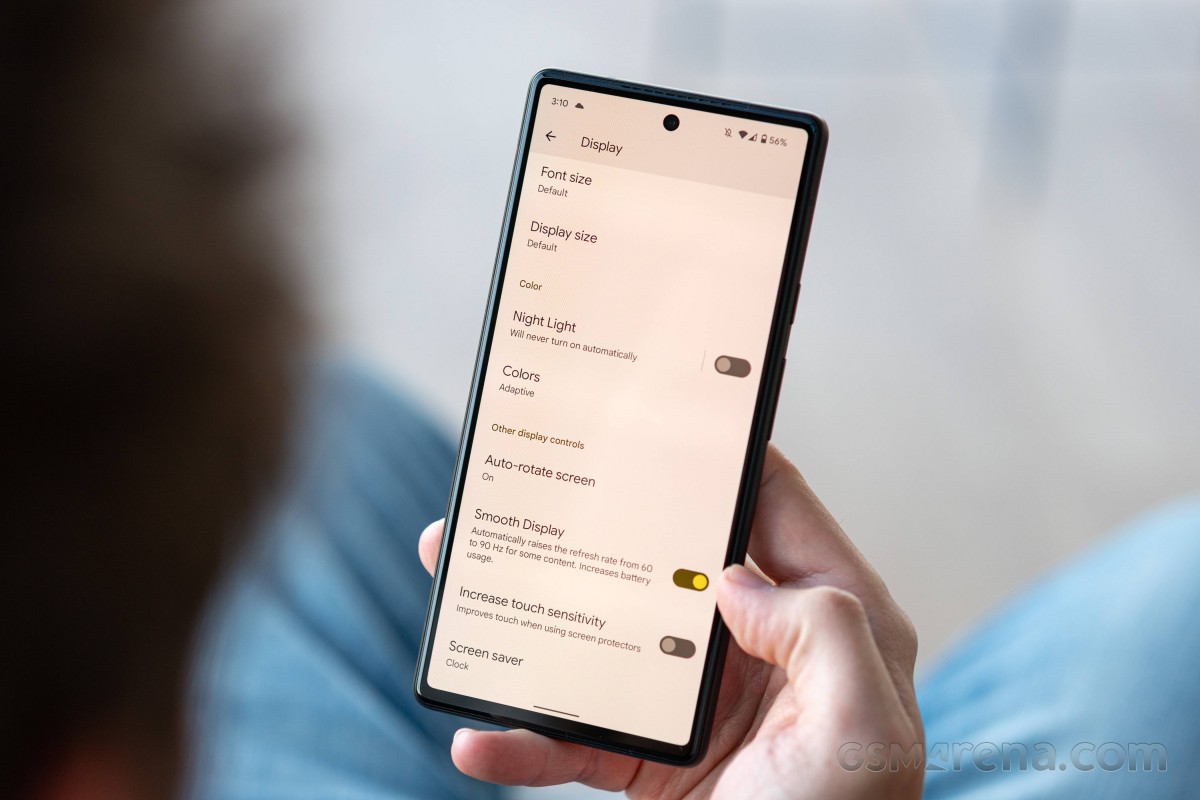
The 90Hz maximum refresh rate of the Pixel 6 is a decent entry into a high refresh rate. It works with a fairly simple auto-switching to 60Hz when you don't touch the screen for a couple of seconds in most apps. Games with high frame rate support get the full 90Hz, which is nice. Also nice is the apparently new toggle in Developer options that lets you force the maximum refresh rate all the time - we hope this makes it to non-Google Android builds in the future.
Google Pixel 6 battery life
The Pixel 6 has a 4614mAh battery inside, slightly smaller than the Pro's 5,003mAh, but an adequate match for the display and chipset.
In our testing, the Pixel 6 was good for over 20 hours of offline video playback (at 60Hz), five more than the Pro. In Wi-Fi web browsing, however, the results are identical at twelve and a half hours (the Pixel 6 was locked at 90Hz). Talk time was lower on the Pixel 6 at 21:14h, still okay in our book. Taking into account the similar standby performance between the two, the Pixel 6 ultimately posted an overall Endurance rating close to its brother's - 86h.
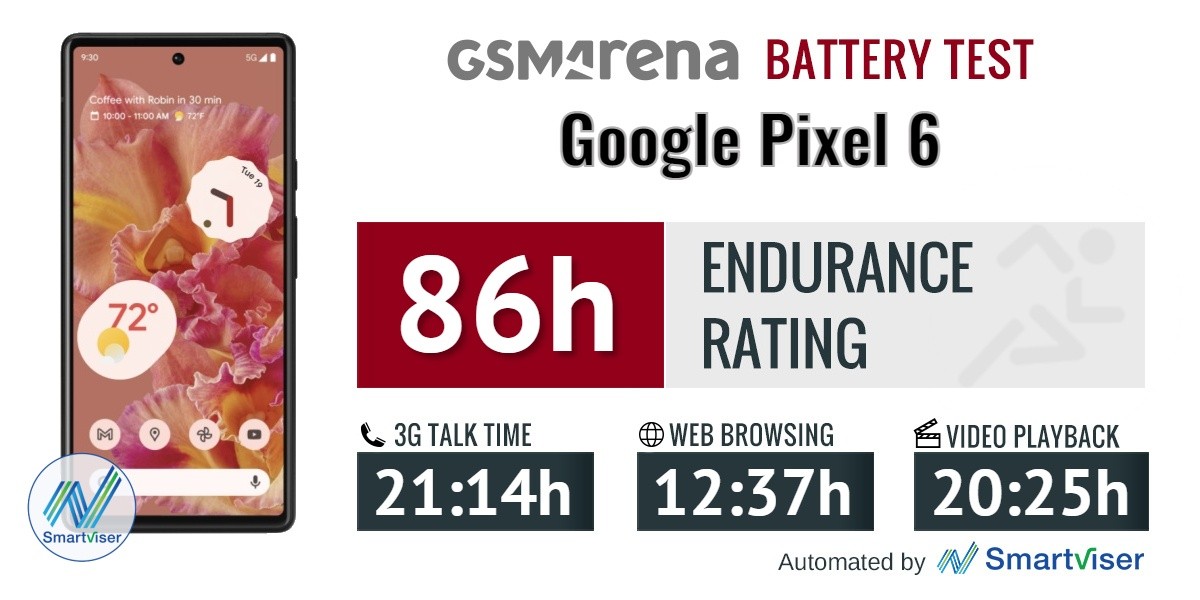
Our battery tests were automated thanks to SmartViser, using its viSerDevice app. The endurance rating denotes how long the battery charge will last you if you use the device for an hour of telephony, web browsing, and video playback daily. More details can be found here.
Video test carried out in 60Hz refresh rate mode. Web browsing test done at the display's highest refresh rate whenever possible. Refer to the respective reviews for specifics. To adjust the endurance rating formula to match your own usage - check out our all-time battery test results chart.
If you're looking to squeeze a bit more battery life out of the Pixel 6, you can run it at 60Hz. We repeated our web browsing test and got two full extra hours for a total of 14:23h. We reckon it's worth it if you know you're going to have a particularly busy day and every minute is important.
Charging speed
The Pixel 6 comes with no charger in the box. Google quotes a 50% figure for a 30-minute charge using their own new 30-watt adapter which supports USB Power Delivery 3.0 with PPS (sold separately, $25 in the US, €29 in Europe). Mind you, they don't explicitly state it actually charges the Pixels at 30 watts.
We tried a third-party 65W PPS-capable adapter and got to 48% in half an hour, close enough to the promised half-full, with the power being drawn maxing out at 20 watts and change. The 0 to 100% test took a lengthy 1:50h.
We repeated the test with an 18W Google adapter, one from the early Pixels and essentially the same unit they all shipped with when they still shipped with chargers. We theorized that people buying Pixel 6s probably have bought Pixels before and have one of these lying around. We got a slightly lower result at the half-hour mark, and more or less the same time for a full charge.
30min charging test (from 0%)
Higher is better
- OnePlus 9
100% - Xiaomi Mi 11
83% - Apple iPhone 13 Pro (20W Apple)
60% - Galaxy S21 5G (25W PD)
55% - Apple iPhone 13
54% - Google Pixel 6 Pro
48% - Google Pixel 6 (65W)
48% - Google Pixel 6 (18W)
41% - Galaxy S21 5G (18W QC3.0)
40%
Time to full charge (from 0%)
Lower is better
- OnePlus 9
0:29h - Xiaomi Mi 11
0:50h - Galaxy S21 5G (25W PD)
1:13h - Galaxy S21 5G (18W QC3.0)
1:25h - Apple iPhone 13 Pro (20W Apple)
1:38h - Apple iPhone 13
1:46h - Google Pixel 6 (65W)
1:50h - Google Pixel 6 Pro
1:52h - Google Pixel 6 (18W)
1:53h
The Pixel 6 supports wireless charging. The certification listing on the WPC website says it complies with the Extended Power Profile for a maximum charging rate of 12 watts using standard Qi charging pads. The second-generation Pixel Stand, on the other hand, should be able to provide up to 21 watts, Google's product pages state.
Speaker test
The Pixel 6 has a stereo speaker setup with the usual configuration - one bottom-firing speaker, one front-firing above the display that also serves as an earpiece. The earpiece is handed the left channel in portrait orientation, while in landscape, the phone will assign the correct channels based on the accelerometer input. Regardless of whether you're only feeding one channel, the other one will produce some sound too, albeit at much lower volume - a fairly common practice.
Bottom speaker • Earpiece/Top speaker
The Pixel 6 earned a 'Good' rating for loudness in our speaker test, on par with the Galaxy S21 and a notch below the iPhone 13. If we'd have to rank the sound quality, the iPhone would get the top position, followed closely by the Pixel, and then the Galaxy behind by some margin.
Use the Playback controls to listen to the phone sample recordings (best use headphones). We measure the average loudness of the speakers in LUFS. A lower absolute value means a louder sound. A look at the frequency response chart will tell you how far off the ideal "0db" flat line is the reproduction of the bass, treble, and mid frequencies. You can add more phones to compare how they differ. The scores and ratings are not comparable with our older loudspeaker test. Learn more about how we test here.
Android 12 and Tensor-exclusive features
Android 12 has been out for some time now and we have a full review of Google's latest OS running on a previous-gen Pixel. The Pixel 6 we have here, however, has some exclusive features enabled by the custom Tensor chipset that are worth some extra words - Voice Typing, Live Translate, and Calling Assist.
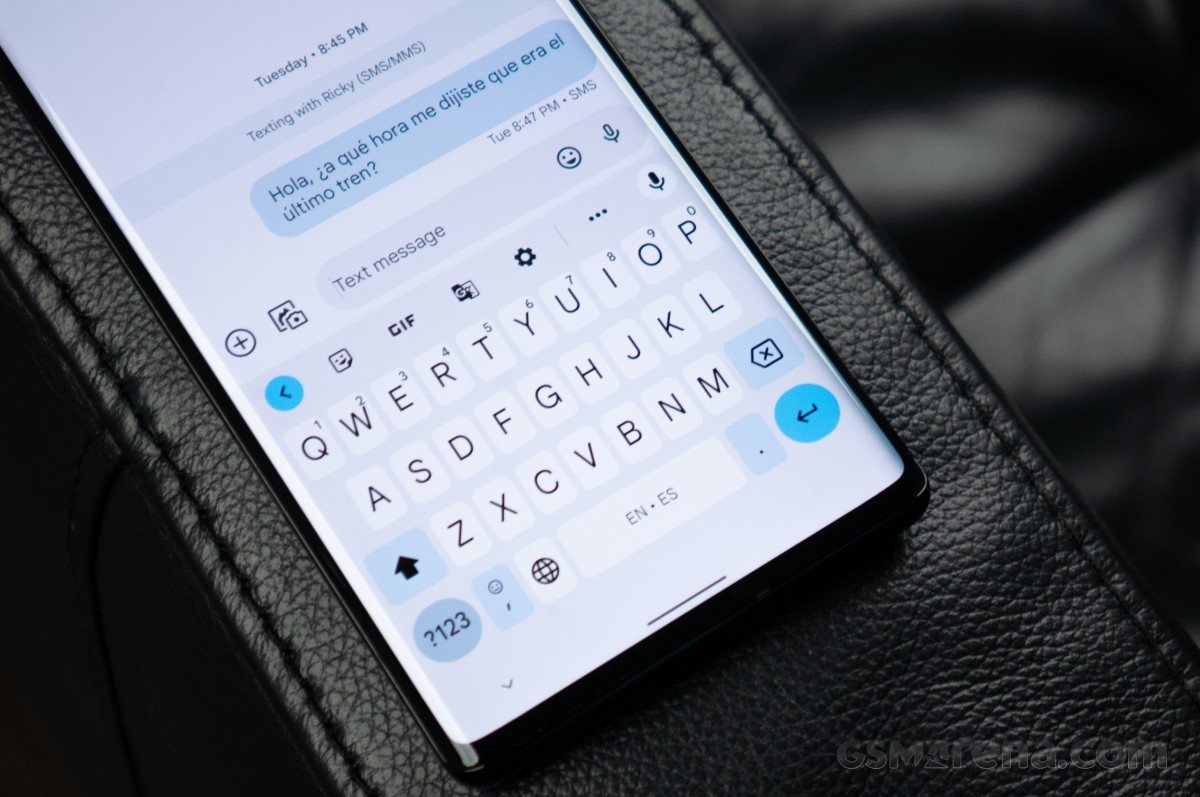
It was always possible to input text using voice with Gboard, but the Tensor chip brings Assistant Voice Typing: a far better way to type by voice. This will work without an internet connection since the language model is on-device and processes language near-instantaneously.
To initiate typing with voice, you can press the microphone button or say "Hey Google, type" and start yapping away. You'll be able to reply with your voice far more naturally since the Assistant will take care of punctuation, so you don't even have to say things like "period" or "question mark".
If you tap on a dictated word, suggestions will now show alternatives that are phonetically close to what you are saying, versus suggestion words that are meant for text Input. You can also say "Clear" to delete the last thing you entered with voice, "Send" (in supported apps), "Clear all" to wipe the entire text field, or "Stop" to discontinue voice input.
You can tap on a word and re-speak it to correct it, or you can move the cursor prior to inserting more text, all without having to press the voice button again. Some emojis can be inserted by voice too, like "smile with teeth emoji," and you can spell out words that Assistant may not understand.

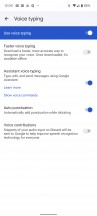
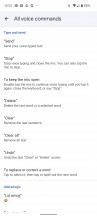
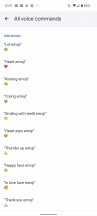
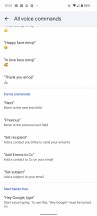
Voice Typing
The new language model enables the much quicker and more reliable transcription of voice to text, thus speeding up Google Assistant's turnaround times for voice queries. The translation is added to the mix as well, which improves Google's Interpreter mode when you need help speaking to someone in their native language, or if you are using a supported messaging app. If you wanted to carry on a text conversation with someone in another language, you could do so, and Google will translate both directions on the fly.
Live Translate worked well enough, except for a couple of bugs. This feature is hidden away in the System Settings, and you have to manually download the language that's to be translated from. The translations were okay, and the results will depend on whether the other person writes in complete sentences. Even still, after setting everything up, the feature works as advertised and beats having to manually translate each message you send and receive.
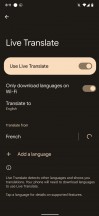
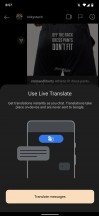



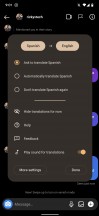
Live Translate via Instagram DM
Live Translate for messaging is currently only supported on a dozen or so messaging apps, and in the following languages: English, French, Japanese, Spanish, German, Italian, Portuguese, Simplified Chinese, Hindi, Polish, and Russian.
Live Translate also works to translate spoken-word content, so long as it's in English, French, German, Italian, or Japanese (Beta) - not in Finnish, for example. Sound coming from a video or audio source can be transcribed and translated in real-time.
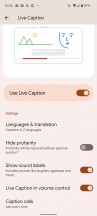
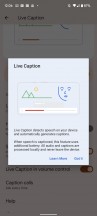
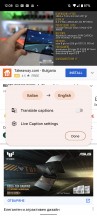

Live Caption with translation
The downside to using this feature is that the actual translation is still a bit slow and clunky. Since the words begin to appear as they are said in their native language, the text you read in the translated language morphs the whole duration of its recital until the sentence is completed and the punctuation is added. This can make reading Live Translated subtitles disorienting and difficult to understand. But if you don't understand the original language, what are your options anyway?




Live Captions translated from French and Japanese content
You may not be able to use Live Translate for apps with copyrighted content. For example, Live Translate wouldn't work for captioning a Japanese TV show on the Netflix app as the feature was disabled for the app. While the feature works as advertised and the concept is quite useful, it seems like it needs another few years before it's fully fleshed out.
As a general taste of Android 12 on a Pixel 6, here are a few screenshots of basic UI elements. You'll note the rounded corners of rectangles, the large quick toggles, the oversized labeling, the creamy accent colors - it's overall a very cozy place to be in.
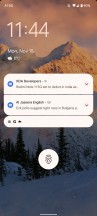
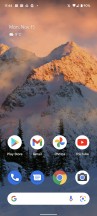
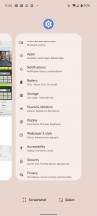
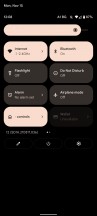
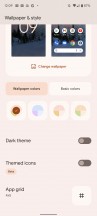
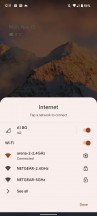
Android 12 on a Pixel 6
Performance and benchmarks
The Pixel 6 is powered by the proprietary Tensor chipset, a joint effort between Google and Samsung. It enables advancements in machine learning and computational photography that Google wouldn't have been able to achieve by using a Qualcomm chip.
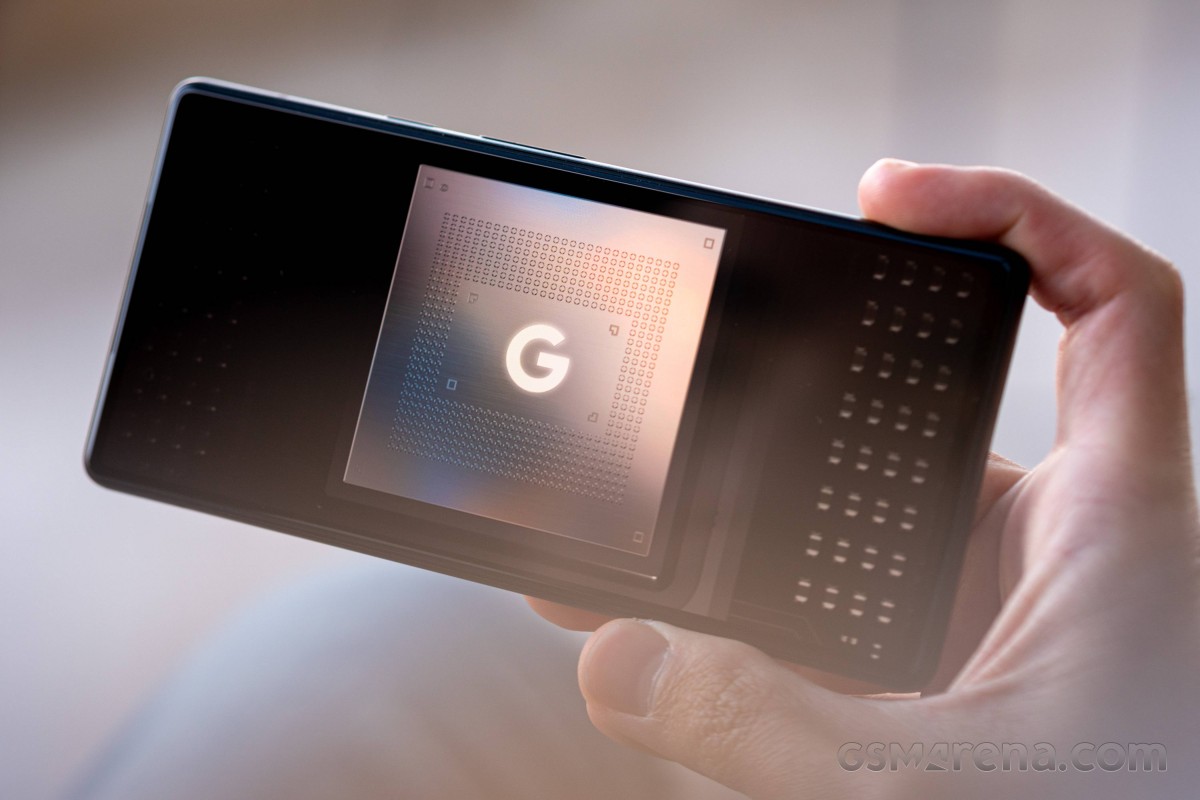
The CPU is in a different setup than competing designs, offering a 2+2+4 core configuration, as opposed to the prevailing 1+3+4 arrangements. You get two powerful Cortex-X1 cores going all the way up to 2.8GHz, a pair of Cortex-A76 cores at 2.25Ghz, and a low-power quad-core cluster of Cortex-A55 cores clocked at 1.8GHz. Google's Tensor is optimized for the dual X1 cores to handle medium-level tasks by using a portion of the workload more efficiently rather than maxing out the mid-cores. For graphics, there's a 20-core Mali G78 MP20.
The TPU (Tensor Processing Unit, after which the whole chip is named) has a machine learning engine that is built for "where ML engines are heading, not where they are today." This component of the Tensor chip handles new camera features, including the new HDRnet algorithm for shooting video and an updated language model used by Google Assistant that enables improved translation speed and accuracy.
This model also enables the new Live Translate features built into Pixel 6 and 6 Pro. There's also a "Context Hub" which handles background tasks or "ambient experiences" like the always-on display and Now Playing features without draining power.
Quoted from Google's press event: "As software applications on mobile phones become more complex, they run on multiple parts of the chip. This is heterogeneous computing." Google's aim with the Tensor chip is that all the components inside work together efficiently rather than optimizing for peak speed.
With that premise, we weren't expecting chart-topping benchmark results, and, indeed, we got rather meh numbers in GeekBench for both single-core and multi-core performance.
GeekBench 5 (multi-core)
Higher is better
- Asus Zenfone 8 Flip
3673 - OnePlus 9
3629 - Asus Zenfone 8
3604 - Asus ROG Phone 5s Pro
3521 - Sony Xperia 1 III
3515 - Xiaomi Mi 11
3489 - vivo X70 Pro+
3469 - Oppo Find X3 Pro
3316 - Galaxy S21 Ultra 5G (Snapdragon)
3244 - Samsung Galaxy Z Fold3 5G
3239 - Samsung Galaxy S21 5G
3238 - Google Pixel 6
2899 - Google Pixel 6 Pro
2831
GeekBench 5 (single-core)
Higher is better
- Sony Xperia 1 III
1130 - OnePlus 9
1129 - Asus Zenfone 8 Flip
1126 - Asus Zenfone 8
1118 - Asus ROG Phone 5s Pro
1117 - Galaxy S21 Ultra 5G (Snapdragon)
1109 - vivo X70 Pro+
1106 - Samsung Galaxy Z Fold3 5G
1095 - Xiaomi Mi 11
1085 - Google Pixel 6 Pro
1042 - Samsung Galaxy S21 5G
1032 - Google Pixel 6
1030 - Oppo Find X3 Pro
926
The Pixel 6 did manage to inch ahead of an Exynos powered Galaxy S21 in Antutu, but that's about it.
AnTuTu 9
Higher is better
- vivo X70 Pro+
837833 - Asus Zenfone 8
799738 - Asus Zenfone 8 Flip
797484 - Samsung Galaxy Z Fold3 5G
752218 - Sony Xperia 1 III
749132 - Asus ROG Phone 5s Pro
735588 - Google Pixel 6 Pro
719815 - Google Pixel 6
676831 - Samsung Galaxy S21 5G
650829
The Pixel 6 is a lot happier when faced with graphics benchmarks, however, and in these it did manage to record some victories against fellow Androids. It was also, understandably, way ahead of the 6 Pro in onscreen benchmarks - it's the same GPU having to drive a lot fewer... pixels here.
GFX Manhattan ES 3.1 (offscreen 1080p)
Higher is better
- Asus ROG Phone 5s Pro
120 - OnePlus 9
119 - Asus Zenfone 8 Flip
118 - Google Pixel 6
117 - Asus Zenfone 8
117 - Oppo Find X3 Pro
113 - Sony Xperia 1 III
111 - Xiaomi Mi 11
111 - Google Pixel 6 Pro
110 - Galaxy S21 Ultra 5G (Snapdragon)
109 - vivo X70 Pro+
105 - Samsung Galaxy S21 5G
97 - Samsung Galaxy Z Fold3 5G
71
GFX Manhattan ES 3.1 (onscreen)
Higher is better
- Asus Zenfone 8
105 - Asus Zenfone 8 Flip
104 - Asus ROG Phone 5s Pro
103 - Samsung Galaxy S21 5G
95 - Sony Xperia 1 III
91 - Google Pixel 6
90 - Google Pixel 6 Pro
65 - OnePlus 9
60 - vivo X70 Pro+
58 - Galaxy S21 Ultra 5G (Snapdragon)
58 - Xiaomi Mi 11
57 - Oppo Find X3 Pro
55 - Samsung Galaxy Z Fold3 5G
40
GFX Car Chase ES 3.1 (offscreen 1080p)
Higher is better
- Google Pixel 6 Pro
70 - OnePlus 9
70 - Asus ROG Phone 5s Pro
70 - Oppo Find X3 Pro
70 - Asus Zenfone 8
69 - Asus Zenfone 8 Flip
69 - Sony Xperia 1 III
68 - Xiaomi Mi 11
67 - Google Pixel 6
66 - vivo X70 Pro+
66 - Galaxy S21 Ultra 5G (Snapdragon)
66 - Samsung Galaxy S21 5G
60 - Samsung Galaxy Z Fold3 5G
55
GFX Car Chase ES 3.1 (onscreen)
Higher is better
- Asus Zenfone 8 Flip
62 - Asus Zenfone 8
61 - Asus ROG Phone 5s Pro
59 - OnePlus 9
58 - Google Pixel 6
57 - Sony Xperia 1 III
54 - Samsung Galaxy S21 5G
54 - Google Pixel 6 Pro
39 - Samsung Galaxy Z Fold3 5G
38 - vivo X70 Pro+
33 - Xiaomi Mi 11
33 - Galaxy S21 Ultra 5G (Snapdragon)
33 - Oppo Find X3 Pro
33
GFX Aztek Vulkan High (onscreen)
Higher is better
- Asus Zenfone 8
45 - Asus Zenfone 8 Flip
45 - Google Pixel 6
43 - OnePlus 9
43 - Asus ROG Phone 5s Pro
42 - Samsung Galaxy S21 5G
29 - Google Pixel 6 Pro
26 - vivo X70 Pro+
26 - Galaxy S21 Ultra 5G (Snapdragon)
25 - Sony Xperia 1 III
24 - Xiaomi Mi 11
24 - Samsung Galaxy Z Fold3 5G
18
GFX Aztek ES 3.1 High (onscreen)
Higher is better
- Google Pixel 6
46 - Asus Zenfone 8
41 - Asus Zenfone 8 Flip
41 - OnePlus 9
40 - Asus ROG Phone 5s Pro
40 - Samsung Galaxy S21 5G
38 - Sony Xperia 1 III
36 - Google Pixel 6 Pro
28 - Samsung Galaxy Z Fold3 5G
25 - vivo X70 Pro+
25 - Galaxy S21 Ultra 5G (Snapdragon)
23 - Xiaomi Mi 11
22
3DMark Wild Life Vulkan 1.1 (offscreen 1440p)
Higher is better
- Google Pixel 6
6832 - Google Pixel 6 Pro
6602 - Sony Xperia 1 III
5807 - Asus Zenfone 8 Flip
5677 - Xiaomi Mi 11
5673 - OnePlus 9
5667 - Asus Zenfone 8
5666 - Oppo Find X3 Pro
5653 - Samsung Galaxy Z Fold3 5G
5635 - Asus ROG Phone 5s Pro
5556 - Galaxy S21 Ultra 5G (Snapdragon)
5547 - Samsung Galaxy S21 5G
5412 - vivo X70 Pro+
5332
This peak performance proved difficult to sustain, and in the 3DMark Wild Life stress test, the Pixel 6's result dropped from a class-leading first run to less than half that at the very last loop. CPU stability wasn't stellar either, with a drop to 61% of peak performance in the CPU throttling test. Naturally, these are synthetic loads and very extremes ones at that, so they shouldn't be taken as a representation of real-world usage.
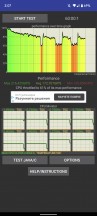
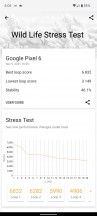
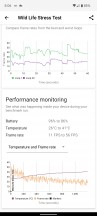
CPU Throttling test • 3DMark Wild Life stress test
Tele-less rear setup, previous-gen selfies
The Pixel 6's rear camera is somewhat of a spiritual successor to the one on the Pixel 5 - it has a 'main', reasonably wide camera, and an ultrawide unit, but no telephoto which is a Pro-exclusive this year. The cameras that it does have, however, the Pixel 6 shares with its more upmarket sibling.
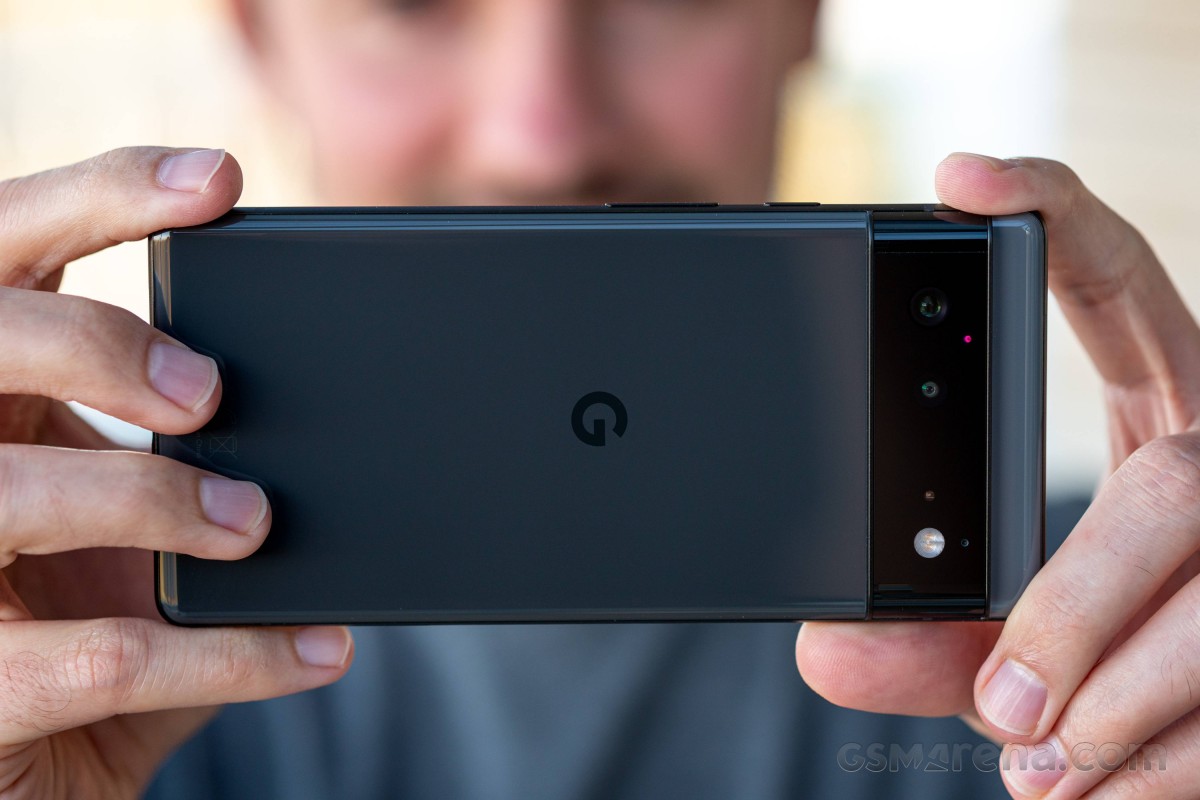
Hiding behind the black strip on the back of the Pixel 6 is the 50MP primary camera. It's based on the Samsung GN1 sensor, a 1/1.31" type imager with 1.2µm pixels and a Tetrapixel color filter array (or Quad Bayer). The 4-to-1 binning means you'd be getting 12.5MP images. The sensor is coupled with a 24mm-equivalent lens (as per EXIF; we've seen 25mm quoted elsewhere) with an f/1.85 aperture and optical stabilization.
The ultrawide camera is updated from the Pixel 5's unit, and while it is the same as on the 6 Pro, we'd say it's not updated enough. Most importantly, it's missing autofocus which means it's no good for nearby subjects, let alone more extreme closeups. Still, it's a decently capable 12MP unit (which outputs 12.5MP images as the main camera, but who's counting) with a conventional RGB Bayer sensor.
Google specs say a 114-degree field of view, which is a rather extreme 14mm equivalent, but that's explicitly when you're shooting RAW. The EXIF data in our JPEGs says 16mm, and we've also seen documents stating 17mm, and those narrower FoVs are more in line with what we see with our eyes.
The selfie camera appears to be directly carried over from the Pixel 5. It's an 8MP unit with 1.12µm pixels behind a 24mm-equivalent lens with an f/2.0 aperture. No autofocus here either.
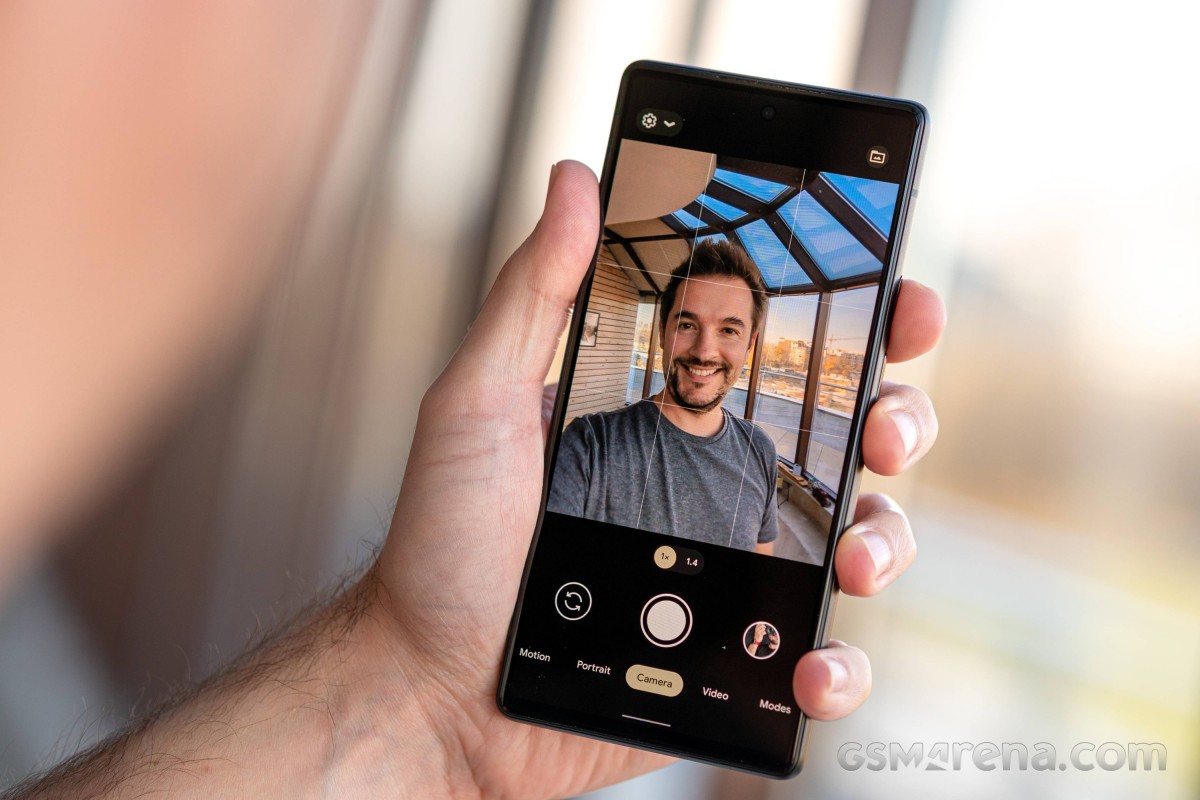
The camera app has been thoroughly reworked for this generation. In the main viewfinder, you'll see a Settings cog in the upper left corner and a location option in the upper right corner where you can decide whether to save photos or videos taken to the Photo Gallery or the Locked Folder.
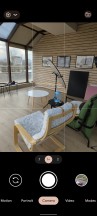
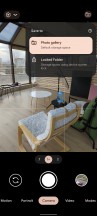
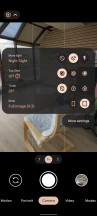
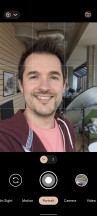
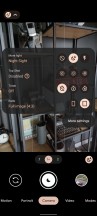
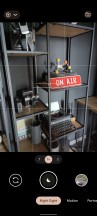
Viewfinder • Storage location • Quick settings • Portrait mode • Auto Night Sight • Night Sight
The camera app will always default to the "Camera" photo mode. From left to right, the shooting modes are: Night Sight, Motion, Portrait, Camera, Video, and Modes which lets you access the Panorama, Photo Sphere, and Google Lens modes. Lens has modes for Translate, Text, Search, Homework, Shopping, Places, and Dining.
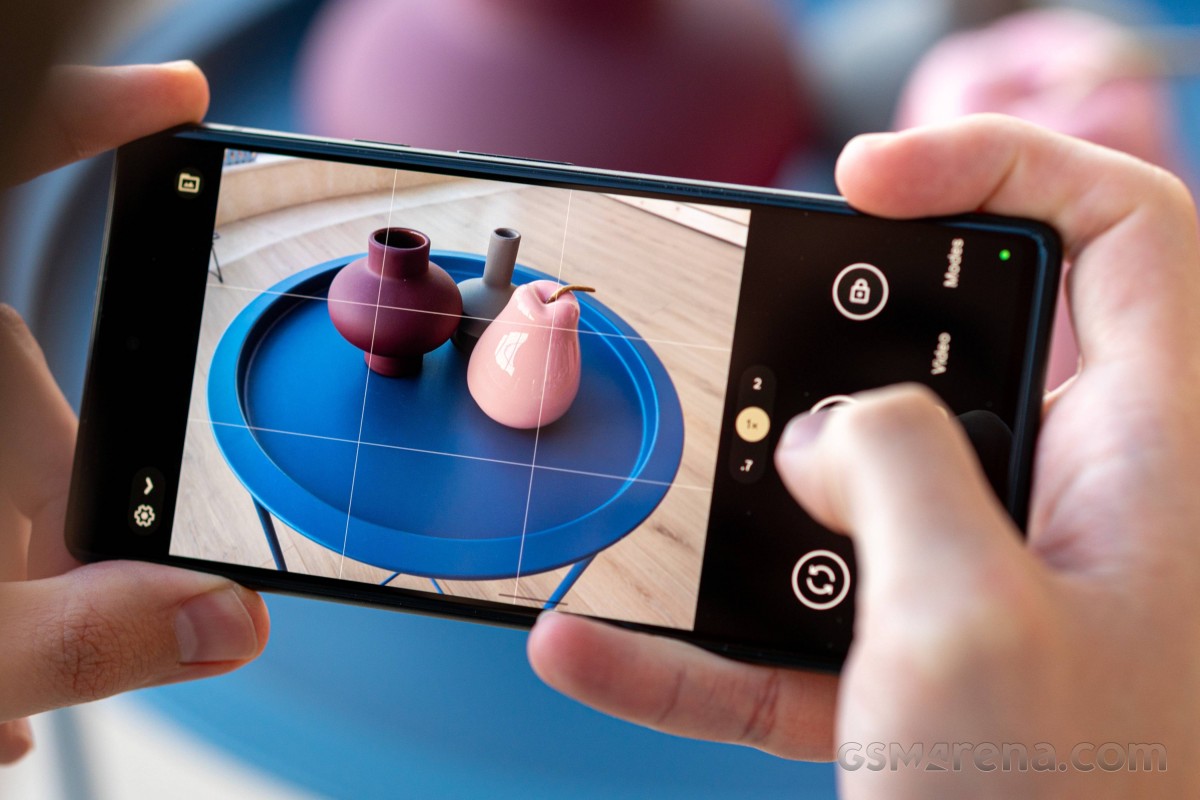
Tapping somewhere in the viewfinder will make a bunch of sliders show up - for white balance, shadow, and light. You can disable the lot of them, if you prefer. An option to shoot RAW images is provided, but you need to specifically enable this one in settings first. There's no setting or mode to make the Pixel 6 shoot at the sensor's native 50MP resolution.
The Motion camera mode is new to the Pixel 6 generation, and it has two shooting options. Action Pan is used for capturing a fast-moving subject by following its path with the phone and blurring the background in the process. Long exposure is the opposite: you press the shutter button to capture something like a train, car trail lights, or something that's moving quickly, and the background stays clear. Motion modes are currently in Beta but available out of the box.
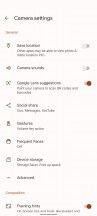
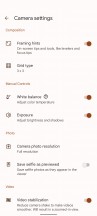
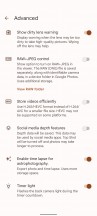
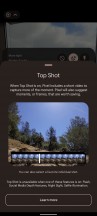
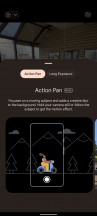
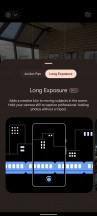
Settings • More settings • Advanced settings • Top Shot • Motion
Daylight image quality
Daylight photos out of the Pixel 6's main camera are properly great. We're seeing nicely high contrast, but also a wide dynamic range with well-developed tonal extremes. Colors are vivid without pushing it into oversaturation territory.
Sharpness, too, is excellent, with a characteristic Pixel rendition to fine detail that some may call gritty, and it's a look most of us here enjoy. Noise, meanwhile, is not a thing you see in the Pixel 6's main camera images.











Daylight samples, main camera (1x)
We had an iPhone 13 Pro handy this time around and shot a few scenes for comparison. The Pixel does a lot better with high-frequency detail in leaves or grass. It also handles high contrast scenes with a lot more grace. It's not a huge difference, but if we must choose, we'd probably give the Pixel the nod.






Daylight samples, main camera (1x): Pixel 6 • iPhone 13 Pro
The Pixel 6 doesn't have a telephoto camera, but it does include a 2x zoom button in the viewfinder. These can very well fool you; they're coming from a dedicated camera at fit to screen magnification which is good enough for sharing around - the colors and dynamic range are the same as 1x shots. Naturally, at 1:1 examination, their crop-and-upscale essence is revealed, and pixel-level sharpness isn't great.








Daylight samples, main camera (2x zoom)
The ultrawide camera of the Pixel 6 is, for starters, not all that ultrawide, certainly not as wide as competing efforts from Apple or Samsung. Its comparatively narrower field of view aside, however, it does capture very good photos. Again, we're talking contrasty images with a wide dynamic range and pleasing, vibrant colors. You get tons of detail, but noise is also present. Corner softening is so minor as to be irrelevant, but there does remain some slight barrel distortion in these 'corrected' images.
A notable omission here is autofocus, so the Pixel 6's ultrawide is best suited to expansive vistas - you can forget about closeups or emphasizing perspective on nearby subjects.












Daylight samples, ultrawide camera (0.7x)
Low-light image quality
The default Camera mode doesn't need the help of Night Sight to produce very good images, though there has to be some image stacking going on anyway. We're getting good, balanced exposures and a wide dynamic range with competent development at both extremes. Colors are accurate and maintain the vividness from daylight shots, there's no saturation loss here. Detail is good overall, though shadows can be slightly mushy, with noise hiding in there.











Low-light samples, main camera (1x), Camera mode without Auto Night Sight
Night Sight introduces some changes, not dramatic, but noticeable still. Shadows and lower midtones get a nudge and improve in sharpness and detail - you get to see textures now where things were too soft to make out before. Point light sources will be rendered with less blown-out areas, revealing the color underneath previously white patches. Pixel deniers may call these photos artificially brightened and not 'realistic', but we'd argue that's how they should be.












Low-light samples, main camera (1x), Night Sight
The regular Camera mode has a provision for Auto Night Sight capture, and that's the default state of the app, though you can disable that behavior. This automatically kicked in for most of our low-light scenes, but it did skip a couple where it deemed the light was enough for regular exposure. Since there's a clear indication in the viewfinder if the phone is applying Night Sight in Camera mode, the rare occasion when it doesn't choose to do so in the dark is unlikely to go unnoticed.
A curious observation is that while these don't get the 'NIGHT' extension in the file name as ones captured in Night Sight mode, they do have the crescent icon in the thumbnail in the gallery - another Google idiosyncrasy. To our eyes, these are identical to the Night Sight shots.










Low-light samples, main camera (1x), Camera mode with Auto Night Sight
Here's how the Pixel 6's Night Sight compares to the iPhone 13 Pro's Night mode. As a general rule, the Pixel will give you brighter images with better-developed shadows, with the magnitude of the gap varying from scene to scene. Perhaps a narrow win in sharpness could also be awarded to the Google phone. In any case, there's not a... ahem... night-and-day difference between them.






Low-light samples, main camera (1x): Pixel 6 • iPhone 13 Pro
At the 2x zoom level, the Pixel 6 returns decent results considering they're sourced from the main camera. With that in mind, it's no surprise that they look similar in terms of color and dynamic range. They're not half bad when it comes to detail either, and despite not being absolutely sharp, there's an adequate level of definition.












Low-light samples, main camera (2x zoom), Camera mode without Auto Night Sight
Night Sight can improve things a bit on the detail front and also help with the dynamic range at the extremes - again, similar results to what you'd get when shooting at 1x. This is also the output you'd get with auto Night Sight enabled, minus the occasional scene where it wouldn't engage.












Low-light samples, main camera (2x zoom), Night Sight
The ultrawide is having a hard time at night with no Night Sight aids. The images tend to look underexposed, and you'd be getting deep and noisy shadows.












Low-light samples, ultrawide camera (0.7x), Night Sight
With Night Sight on, on the other hand, things are looking a lot better. Exposure is dramatically improved, detail in the shadows is lifted, and there's a decrease in noise too. There's not much change in the highlight region, but we wouldn't say it needed improvement - point light sources were already rendered well in Camera mode.












Low-light samples, ultrawide camera (0.7x), Camera mode without Auto Night Sight
Once you're done with the real-world samples, head over to our Photo compare tool to see how the Google Pixel 6 stacks up against the competition.


Google Pixel 6 against the Galaxy S21 5G and the iPhone 13 in our Photo compare tool
Portrait mode
Portrait mode on the Pixel 6 comes in two zoom levels labeled 1x and 2x, but they don't really correspond to the main camera's 1x and 2x. The 1x is more of a 1.3x (which, coincidentally, is the label it gets if you first tap on 2x in Camera mode, and then switch to Portrait mode - just pixel things), and that's good - it puts far enough away from your subject for the distance not to be uncomfortable, while also improving the perspective, without affecting sharpness too much.
So yes, portraits shot at 1x zoom are decently sharp on your subject - not pin-sharp and with some liberal sharpening applied, but still with a very Pixel-like texture to them. Subject separation is generally good, even with messy hairstyles, but it's far from infallible, and we did get some mix-ups around clothing lines. The default background blur lever is a bit much, too, we'd say, and makes for a somewhat artificial look. You do get to tweak that in the gallery, though, so it's not a big deal.







Portrait mode samples, 1x
The 2x zoom level, we're including only for thoroughness' sake - it's just plain bad, don't use it.







Portrait mode samples, 2x
Selfies
The selfie camera on the non-Pro Pixel 6 is different from the Pro's, and this one can't cover quite as wide a field of view - that said, the 24mm equivalent here is anything but limiting. You get sharp and detailed 8MP images with minimal noise. Dynamic range is excellent, and even scenes with strong backlight will be rendered well. Colors are again very pleasing with a hint of extra warmth on skin tones, at least on this Caucasian male subject.








Selfie samples
Selfie portraits don't bring any real changes in global or pixel-level properties - colors are the same, HDR is in full blast, detail is sharp where it needs to be. Subject separation is, dare we say, better in selfies than on the rear camera, and the more conservative blur level here makes for a more organic look too.








Selfie samples, Portrait mode
Motion
Motion mode is still in beta, and that showed in our attempts to capture an Action Pan shot. Out of more than a dozen attempts, we got a couple of usable shots. They do look... interesting, but closer inspection reveals flaws in subject detection and not great detail on the subject either. Additionally, timing the shot isn't straightforward - we never seemed to be able to get the subject in the center of the frame.



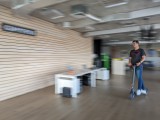
Action Pan
Long exposure is a bit easier - you just stand there, not following the subject necessarily, though again, the timing can be hit and miss.




Long Exposure
As a novelty, we'd say the Motion feature is worth a few tries.
Magic eraser
In the novelty category is also the Magic Eraser tool in Google Photos. It does get points for ease of use as it requires very little input from the user - you just need to draw around the object you want removed from your photo, and it will do it's thing. The results are okay, if you don't go looking for imperfections from up close.








Magic Eraser samples: Before • After
4K60 and all sorts of stabilization modes
The Google Pixel 6 can record video up to 4K60 with its main camera, or 4K30 with the ultrawide. You can also do up to 4K60 at the 2x zoom level, but don't expect greatness. The h.265 was enabled by default on our review unit, but you can flip the toggle off to the more common (and less efficient) h.264.
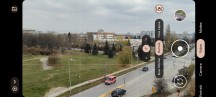
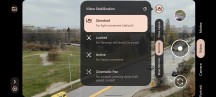
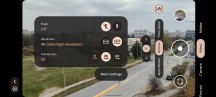
Video recording UI: Viewfinder • Stabilization options • Quick settings
The main camera's 4K30 (48Mbps bit rate in h.264) footage is very good. Exposure is accurate, dynamic range is superb, colors are lively, perhaps a pinch overboard. Sharpness and detail are on par with competitors from Apple and Samsung, all of them a notch below the Mi 11 Ultra.
At 2x zoom, 4K is on the soft side, though you could call the footage acceptable if you're viewing it on a smaller screen or from further away. But then why bother shooting in 4K in the first place.
The ultrawide's 4K capture maintains the positive impression, delivering a great match in colors and dynamic range to the main camera. The video is sharp and detailed, too, albeit marginally less crisp than what we got from the iPhone 13 Pro and the Galaxy S21.
In low light, the main camera does a respectable job, better than what the iPhone can do in similar conditions, and captures very good detail in areas of at least decent lighting. Shadows can be murky, though, and the dynamic range isn't very wide.
4K at the 2x zoom level is too soft to pass for 4K. We'd say it rivals decent 1080p footage shot in these circumstances.
The ultrawide isn't happy staying after dark and protests by capturing soft and noisy clips.
The Pixel 6 has a global video stabilization toggle in settings and a more granular stabilization mode selector right in the viewfinder. The default is 'Standard'; it's tailored for light movement, and you can use that at all three zoom levels.
In this mode, the main camera produced very stable clips with a well ironed-out walking-induced shake, smooth pans and virtually still recording when just pointing the phone somewhere. It's the same story on the ultrawide.
'Cinematic Pan' can record in both 4K and 1080p, only on the main camera. It captures at 60fps but encodes the video at 30fps for a half-speed light slow-motion effect.
There's also an 'Active' mode, for heavy movement, which uses the ultrawide camera only and still offers 1x and 2x zoom levels. You don't get to choose the resolution or frame rate here, it's 1030p at 30fps. The video quality drops significantly as a combined result of the lower resolution and the crop, but for 'heavy movement' where the action is more important than the quality, it'll probably be good enough. Again, the video is eerily steady when you're just holding the phone pointed in one direction.
There's actually a dedicated mode for that, sort of. It's called 'Locked,' and it's designed for shooting distant subjects without moving the phone. It offers 2x and 5x zoom levels and a choice of 1080p or 4K and 30fps and 60fps.
Since the Pixel 6 only really has a 1x actual camera, the 5x setting is perhaps a remnant of the Pixel 6 Pro's camera app that someone didn't think to remove from the non-Pro's code - the result is properly bad.
At 2x, however, while not spectacularly sharp, the footage is decent in terms of quality and pretty great when it comes to stability. You can hear the wind we were battling while recording this, and the phone kept things remarkably steady, about as steady as in the video further up the page that was shot on a tripod with no software stabilization.
'Standard' mode works at 2x as well, of course. It's about as good as 'Locked', but not quite. Or the marketing got to us, and Locked just sounds better than Standard.
Here's a glimpse of how the Google Pixel 6 compares to rivals in our Video compare tool. Head over there for the complete picture.
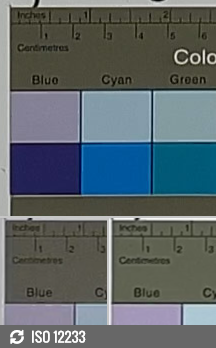


Google Pixel 6 against the Galaxy S21 5G and the iPhone 13 in our Video compare tool
Competition
The Pixel 6 Pro is the true Google flagship, and it's that model's job to stand up to the competition of the Pro Maxes and the Ultras of this world. The Pixel 6, meanwhile, with its more modest aspirations (and asking price) faces a crowd not quite as tough.
That's not to say that the Galaxy S21, for example, doesn't have it beat in one thing or another. The Galaxy's display does support a higher refresh rate and, while not strictly telephoto, its zoom camera can get you better reach than the Pixel 6's setup, and it won't leave you wanting with its other cameras either. The Galaxy is also an obvious choice if you want a smaller phone, offering some 40g of weight savings. The S21 is more expensive, and while a €50 premium isn't all that much in Europe, the gap in the US is a lot more tangible at $800 vs. $600 for the Pixel. And for all that, you'd still be getting a plastic-backed Galaxy.
The Pixel 6 is at a similar price advantage in the US against the iPhone 13 ($800), but now also in Europe, where Apple charges €900 for a base version 13 non-Pro. Telephoto-challenged both of these, each will likely keep you satisfied with their camera performance, if in slightly different ways. Battery life is similar, charging slowness is comparable, displays are equally bright, though the Pixel scores a point here for its 30 extra Hertz. The iPhone is appreciably lighter if that's a consideration. Peak Android vs. iOS is a whole separate debate in itself. Ultimately, the Pixel seems like the better deal.
Speaking of deals, the Zenfone 8 with its $630/€650-ish price tag just about qualifies as one. Another notably smaller handset, the Zenfone is for those that would have liked a mini Pixel, only to be left hanging by Google. The Zenfone has a 120Hz display and charges slightly faster, but neither is a game-changer, and there aren't any massive differentiators when it comes to objective stuff - unless, that is, you're a particular fan of the Zenfone's headphone jack. It's mostly the size that will settle this and, as with all others here, software.
The OnePlus 9 comes in at $660/€700, so a reasonable stretch if you're okay with the Pixel's $600/€650 MSRP. The OP comes with a couple of advantages, including way faster charging and a higher refresh rate display, which is also as big as the Pixel's - unlike the others above. The OP isn't IP-rated, so that's a win for the Google phone. We're leaning towards the Pixel altogether.
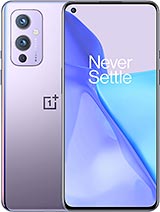
Samsung Galaxy S21 5G • Apple iPhone 13 • Asus Zenfone 8 • OnePlus 9
Verdict
The Pixel 6 has us muttering some valid if small-ish, complaints. Competitors have largely moved to 120Hz displays, and this one is still at 90Hz, though the jump from 60Hz to 90Hz is perhaps the more visible one. Charging is slow in the grand scheme of things, but about alright in the Pixel 6's context where that doesn't seem to be a priority. Tensor throttles, but so do the competing high-end Snapdragon/Exynoses. And for all its tendency to pick up lint from your pockets, the camera strip on the back is a rarely interesting-looking design choice.
Google being a software company in the first place, it's the Pixel's take on Android that is a key selling point, and we're fans of the direction it's going with UI this year. The on-device software features enabled by that occasionally throttling Tensor are unique to the lineup and can be of real help for the right user. And for all the catching up that the competition has done in the computational photography field, the Pixel 6 remains a class-leading cameraphone - that can be appreciated by everyone.
The one truly major downside of the Pixel 6 that we can't dismiss easily is the fact that it's only available in a dozen countries. That's just the reality of Google's smartphone business and not something we see changing soon or at all. Going through hoops to import one elsewhere might require some proper motivation and justification. But if you're in one of those countries where Google officially sells a Pixel 6, just get one.
Pros
- Standout rear design is unique to Pixel 6s.
- Beautiful UI with fun and colorful elements; extended firmware update support; newly enabled Voice Typing and on-device voice to text processing.
- Google Tensor chip offers great all-around performance and excellent graphics performance.
- Great all-round photo and video quality across all four cameras.
Cons
- Camera bump prone to accumulating dust.
- The display maxes out at 90Hz, others do 120Hz.
- Charging can be faster.
- Tensor chip throttles under sustained peak load.
- Limited availability.
0 Response to "Google Pixel 6 review"
Post a Comment