Smart Android And Trik-Commenting on Andorid indeed never endless, because smart devices this one is often updated every certain amount of time. So that the market can always be garapnya menerinya with pleasure. And it is not denied if this device has become the lifestyle of each society. To not wonder if the 6th business information and many are turning to mobail smartphone. With Android which thoroughly dominated the mobile industry, choosing the best Android smartphone is almost identical to choose the best smartphone, period. But while Android phones have few real opponents on other platforms, internal competition is intense.
Introduction
The vivo X50 trio has been around for a while, but the flagship vivo X50 Pro+ has been eluding the public since its announcement. While the regular Pro bragged with gimbal-like stabilization and all-round package, this Pro+ version shifts the focus towards performance and photo quality.
The X50 Pro+ upgrades the X50 with an even more fluid 120Hz screen, a faster and flagship-grade Snapdragon 865 chip, speedier storage, and, of course, a bunch of camera sensors of higher quality.
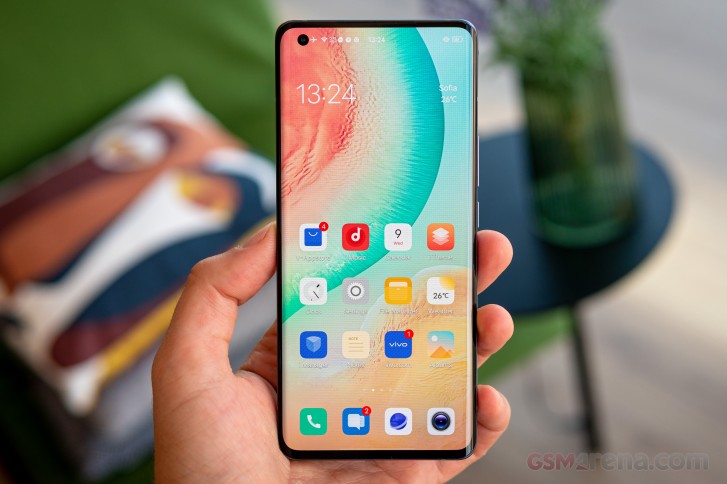
The AMOLED screen remains of the same size and resolution, its refresh rate is now 120Hz, up from 90Hz on the X50 Pro. The Snapdragon high-end bump is surely a welcome addition, but we won't lie, it's the camera that intrigued us the most. The X50 Pro was a versatile shooter and impressed us with its gimble module, but we weren't blown away by its photo prowess.
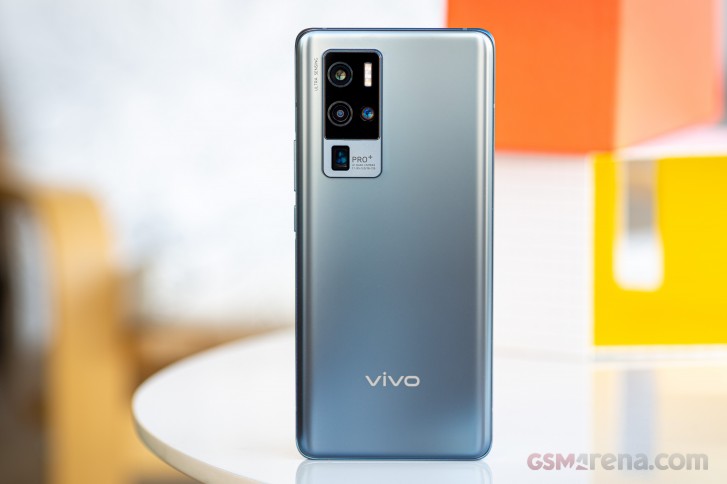
Now, vivo tries to up its camera game with a brand new sensor for the main shooter - Samsung's 50MP ISOCELL Plus GN1, coupled with an f/1.85 24mm lens and optical stabilization. The sensor behind the periscopic lens for 5x optical zoom is now 13MP, up from 8MP on the X50 Pro. The portrait snapper, a.k.a. the one for 2x optical zoom, gets to enjoy a 32MP shooter, once again up from 13MP on the X50 Pro. And thanks to those high-res promotions, the X50 Pro+ joins the elite league of 8K-capable smartphones.
The X50 Pro+ beats the X50 Pro with two new features - 44W fast charging (up from 33W), and the option to buy it with an eco-leather back (Oppo Find X2 Pro anyone?). And that about rounds up the highlights.
Vivo X50 Pro+ specs
- Body: Aluminum frame, tempered glass front, eco leather or tempered glass back; 158.5 x 73 x 8.8 mm, 192g;
- Display: 6.56" AMOLED, punch-hole notch, 2376 x 1080px resolution, 398ppi; 120Hz; HDR10+.
- Rear cameras: Main: 50MP, Quad-Bayer filter, 1.2µm pixel size, 24mm equivalent focal length, f/1.9 aperture, Dual Pixel PDAF, OIS. Ultrawide angle: 13MP, 1/4.0", 1.12µm, f/2.2, 16mm, AF, ultra macro. Portrait telephoto: 32MP f/2.1, 50mm, 0.8µm pixels, 2x optical zoom, PDAF. Long-range telephoto: 13MP with periscope 135mm f/3.0 OIS lens, 5x optical zoom, PDAF. Triple-LED dual-tone flash.
- Video recording: Main - 8K, 4K@60fps, rest - up to 1080p@30fps. EIS and OIS (where available)
- Front camera: 32MP, 1/2.8", 0.8µm, f/2.5 26mm lens.
- OS/Software: Android 10; Funtouch 10.5.
- Chipset: Qualcomm Snapdragon 865: octa-core CPU (1x2.84 GHz Kryo 585 Prime & 3x2.42 GHz Kryo 585 Gold & 6x1.8 GHz Kryo 585 Silver), Adreno 650 GPU.
- Memory: 8GB/12GB of RAM; 128/256GB UFS 3.1 storage.
- Battery: 4,350mAh; 44W fast charging.
- Connectivity: Dual-SIM; 5G; LTE-A, USB-C; Wi-Fi a/b/g/n/ac; dual-band GPS; Bluetooth 5.1; NFC
- Misc: Under-display fingerprint reader; single down-firing speaker.
Currently, the X50 Pro+ is available only in China, and vivo has no plans to launch it in other markets. You can, of course, buy it and ship it to your country if that's what you want. Today, we will find out if this is worth the hassle and if vivo's best camera to date is also among the best on the market, too.
Now, let's unbox this mysterious X50 Pro+ and see what it is made of.
Unboxing the vivo X50 Pro+
The vivo X50 Pro+ comes packed in a big black box, and it contains everything you may need with this phone. Inside, you will find a 55W charger, a 5A-rated USB-C cable, and a transparent silicone case.
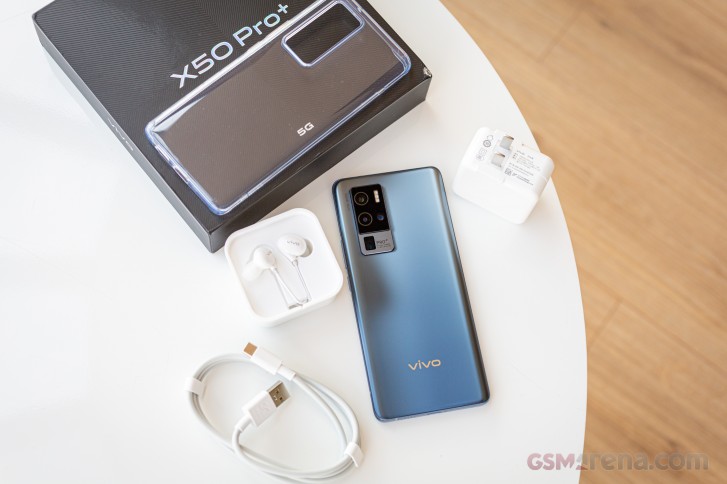
The box also contains a high-quality pair of in-ear vivo headphones (with a mic) ending on a USB-C plug and the SIM ejection tool.
Design, build, quality
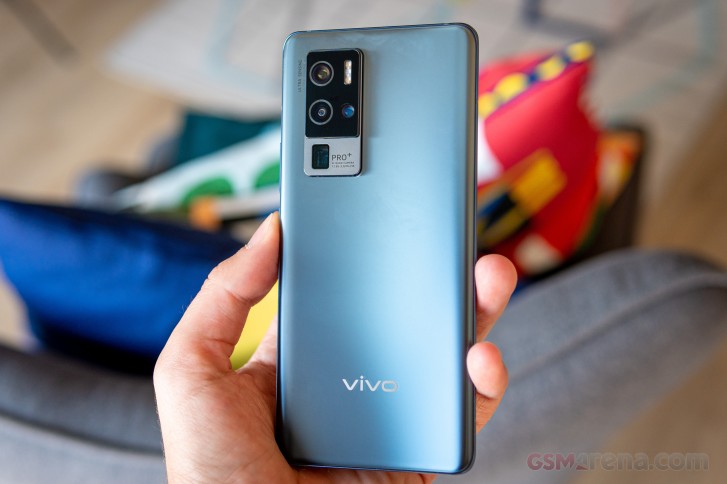
The vivo X50 Pro+ has the same outer shell as the X50 Pro, but that is hardly a surprise. The regular version of the Plus is a glass-sandwich phone with an aluminum frame, while the limited edition has the back draped with eco-leather.
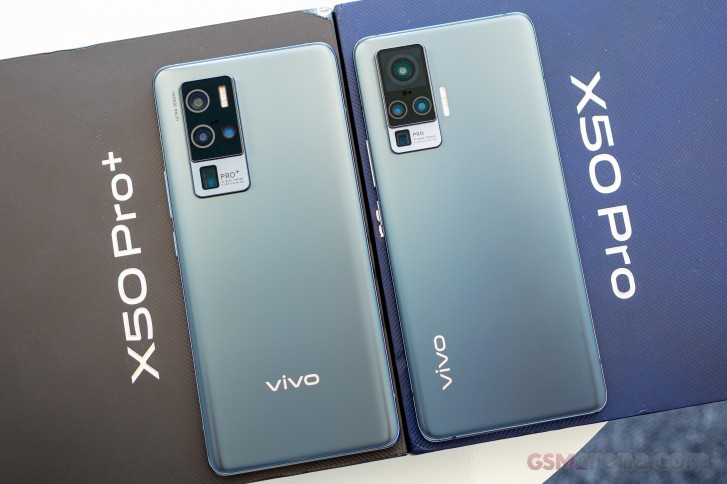
We have the glass version with Alpha Gray paintjob, while the other option, as we mentioned, is Camel leather. Hold your horses just yet, it is not a real camel leather but eco-leather.
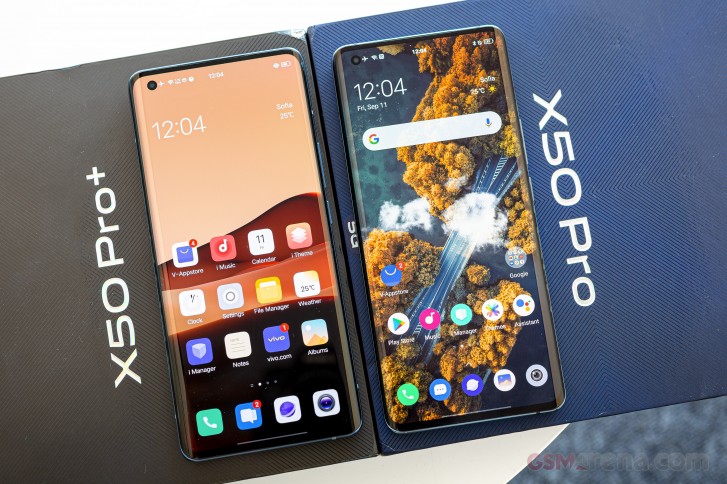
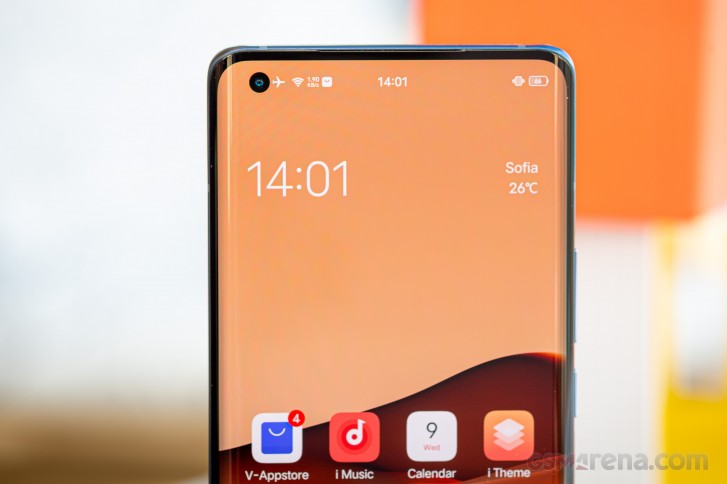
So, the entire front of the X50 Pro+ is taken by the 6.56" AMOLED screen. It has tiny bezels and its protective glass is slightly bent towards the frame around the longer sides. It's a 1080p+ screen with 120Hz refresh rate and HDR10+ support and it looks gorgeous right out of the bat.
There is a small punch hole around the top left corner to make way for the 32MP selfie camera. The earpiece is rather invisible, hidden in one super thin gap between the frame and the glass.
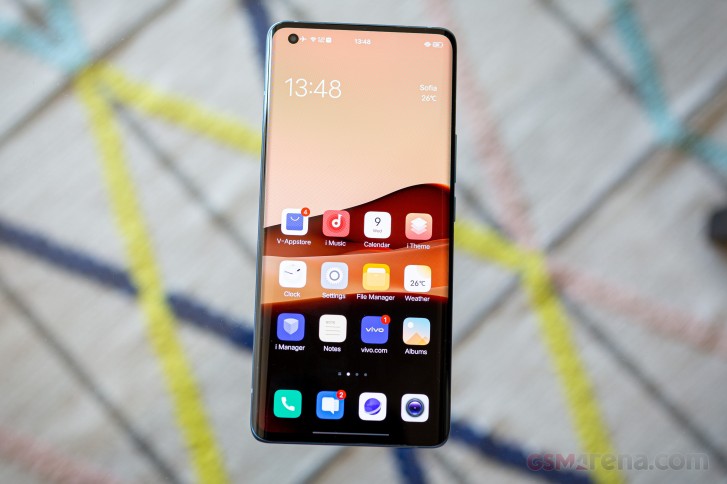
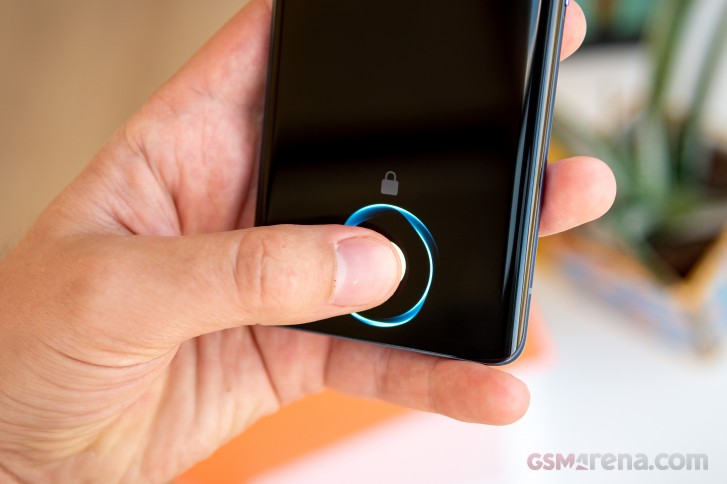
The X50 Pro+, just like the plethora of AMOLED-packing phones, has its fingerprint scanner underneath the screen. It's of the optical kind and works rather fast. The accuracy is on par with the best in this business, so we have no complaints.
The back is just as curved as the front and made of tempered glass. It is painted in Alpha Gray, which is more like mystical blue, but let's not dwell on that. The glass finish is frosted, which makes the color transition silky-smooth from dark blue to a bit lighter hue. The effect is nice and the opposite of flashy and we do like it.
The quad-camera setup is on the back, of course, and it looks a bit different from the X50 Pro's. It also has two levels - the lower one contains the periscopic lens of the 13MP camera for 5x optical zoom, while the upper one has the 50MP primary, 32MP portrait and the 13MP ultrawide shooters. The triple-LED flash is also here, as well as the laser emitter and receiver that assist the autofocus.
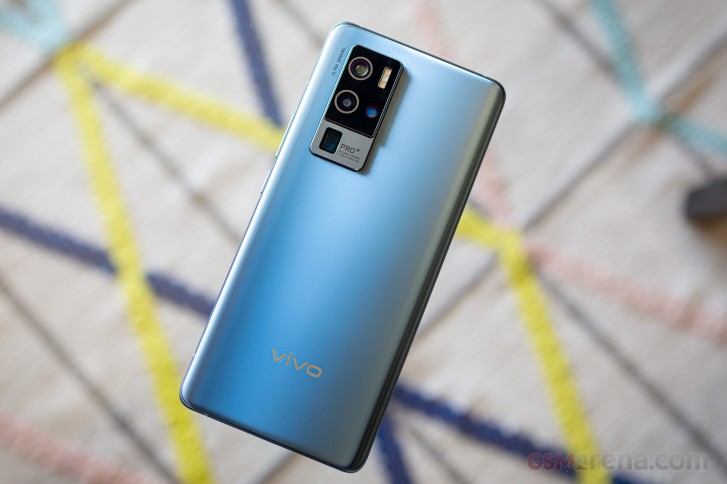
The whole camera is protruding just like many of the competitors', which is still unavoidable.

The aluminum frame is very thin around the long sides and flat at the top and the bottom. On the right are the volume and power keys.

The bottom has the dual-SIM tray, the speaker grille, the mouthpiece, and the USB-C port. And since the frame is rather flat here, the X50 Pro+ can stand upright on its bottom, just like the X50 Pro.
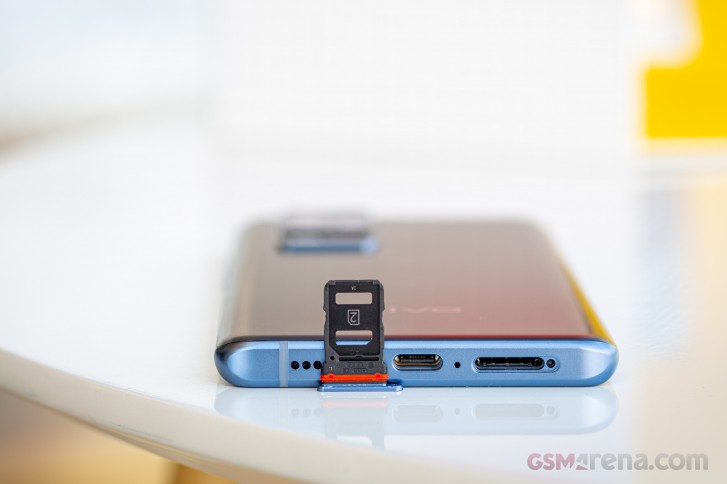
The X50 Pro+ measures 158.5 x 73 x 8.8 mm and weighs 192 grams - about 1mm thicker than the X50 Pro and 11 grams heavier.
So, the frosted back looks beautiful and is mostly fingerprint resistant, but it is not grippy, not at all. The X50 Pro+, no matter how flagshipy it is, it just doesn't feel secure in hand and we recommend using the bundled silicone case. It doesn't hide much of its signature looks, but you will get the much-needed safety.
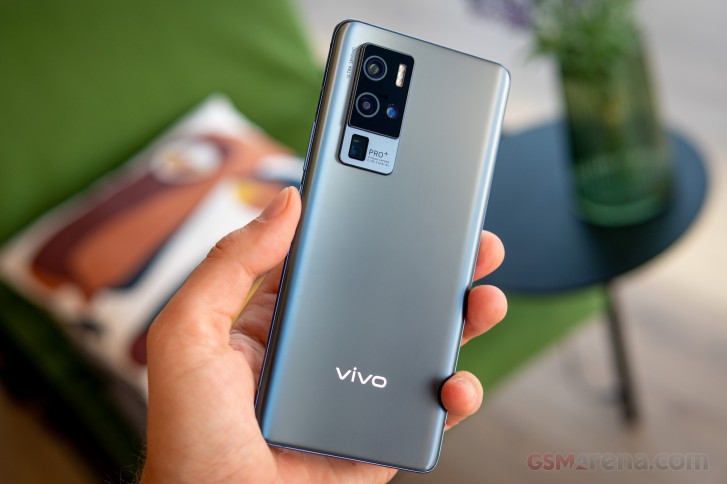
The vivo S50 Pro+ is not water-proofed, not even splash-resistant. It does appear to feature some rubber seals here and there, but there is no official word on any sort of ingress protection, so if you have this phone - it must always stay away from water.
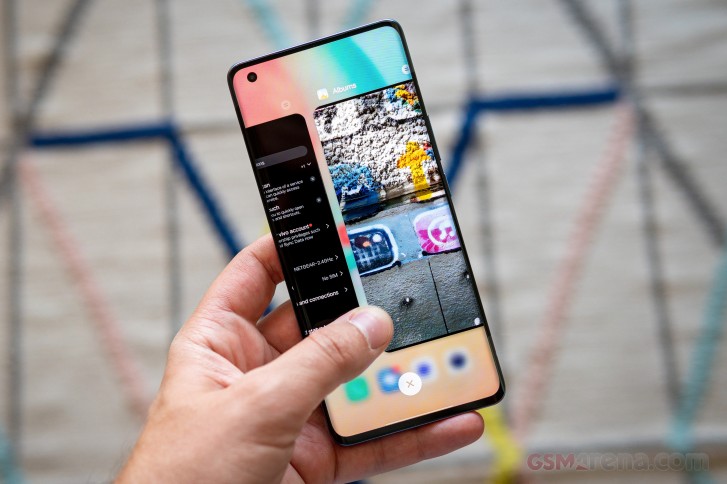
Finally, we have to say we liked the X50 Pro+ just like we loved the X50 Pro. It is a cool phone to have and handle, the frosted glass feels nice in hand, and the phone is not bulky at all. The curves help, of course, as the small bezels and the top-notch screen. It is among the more compact flagships on the market and that will mean a lot to at least a few people. But let's not forget the X50 Pro+ is a tough one to find on the market though.
Superb AMOLED screen
The vivo X50 Pro+ packs a 6.56" AMOLED screen with extended 1080p resolution and rounded edges, and there is a tiny punch-hole to accommodate the selfie camera.
The screen resolution is 2,376 x 1,080 pixels making for sharp 398ppi density. The panel is covered with a curved tempered glass, and additionally, vivo is shipping the phone with a very thin protective film pre-applied at the factory.
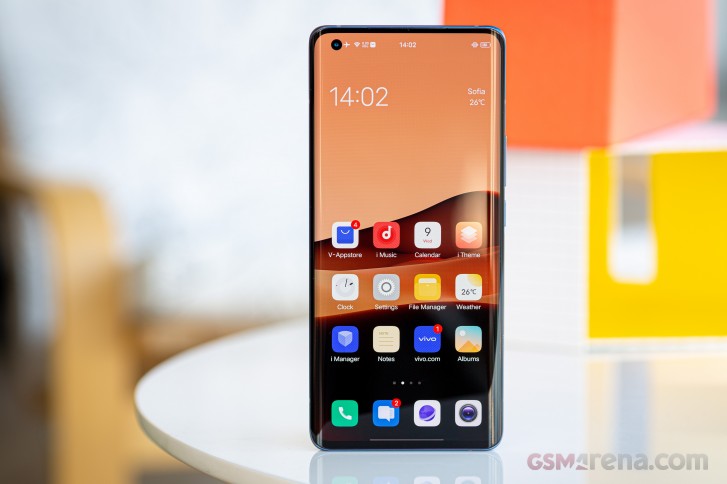
The vivo X50 Pro+ screen supports 120Hz high refresh rate. You can choose between 60Hz, 120Hz, or Smart Switch based on content.
The OLED screen supports HDR10+ and is recognized as such by all popular apps as such. Unfortunately, at this state the X50 Pro+ supports the basic Widevine L3 DRM, meaning the popular streaming apps will serve SD content only. Let's hope vivo improves this with a software update.
We did some brightness measurements and we found that X50 Pro+ panel to be quite bright for an OLED. Using the brightness scrubber, we got a maximum brightness of 500 nits. When the screen uses Adaptive Brightness, it can light up as high as 733nits - a great performance, indeed.
Finally, the minimum brightness we were able to achieve with white was 2.2 nits - so an excellent result.
| Display test | 100% brightness | ||
| Black, |
White, |
||
| 0 | 499 | ∞ | |
| 0 | 733 | ∞ | |
| 0 | 489 | ∞ | |
| 0 | 503 | ∞ | |
| 0 | 498 | ∞ | |
| 0 | 811 | ∞ | |
| 0 | 510 | ∞ | |
| 0 | 858 | ∞ | |
| 0 | 538 | ∞ | |
| 0 | 888 | ∞ | |
| 0 | 496 | ∞ | |
| 0 | 803 | ∞ | |
| 0 | 425 | ∞ | |
| 0 | 531 | ∞ | |
| 0 | 455 | ∞ | |
| 0 | 760 | ∞ | |
| 0 | 504 | ∞ | |
| 0 | 1024 | ∞ | |
| 0 | 398 | ∞ | |
| 0 | 894 | ∞ | |
| 0 | 536 | ∞ | |
| 0 | 871 | ∞ | |
The vivo X50 Pro+ display supports DCI-P3 and sRGB color spaces. You get to choose between Standard, Normal, or Bright color modes. In each of these, you will get a color temperature slider going from cool to warm.
The default Standard mode got us an average DeltaE of 3.9 against DCI-P3 targets. If you move the temperature slider midway to Warm, you can get rid of the blue tinge over the white and gray hues and get higher color accuracy with an average DeltaE of 2.2 or so.
The Bright Mode is pretty much the same as the Standard, with more saturated red and green hues.
With Normal mode, we measured an average DeltaE of 1.7 against sRGB targets.
Overall, color reproduction is very good on the X50 Pro+ and it can be even excellent if that's what you want.
Battery life and charging
The vivo X50 Pro+ is powered by a 4,350 mAh battery. The phone supports 44W fast charging, faster than 33W's on the X50 Pro. The X50 Pro+ ships with the an even faster 55W charger - it gets the battery from flat to 60% in 30 mins and to 100% in 70 mins.
The X50 Pro+ clocked great Screen-On-Times on our battery tests - it can last more than 12 hours in web browsing, while you can watch movies for nearly 18 hours.
The standby performance turned out to be about the average for a 4,300 mAh battery and everything combined resulted into the very good endurance rating of 93 hours.
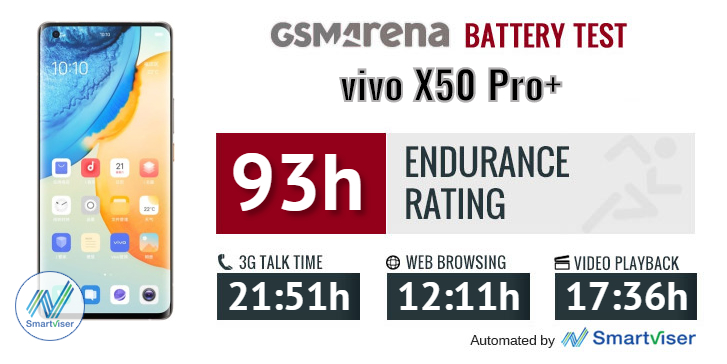
Our battery tests were automated thanks to SmartViser, using its viSer App. The endurance rating above denotes how long a single battery charge will last you if you use the vivo X50 Pro+ for an hour each of telephony, web browsing, and video playback daily. We've established this usage pattern so that our battery results are comparable across devices in the most common day-to-day tasks. The battery testing procedure is described in detail in case you're interested in the nitty-gritty. You can check out our complete battery test table, where you can see how all of the smartphones we've tested will compare under your own typical use.
Speaker test
The vivo X50 Pro+ is equipped with a single loudspeaker on the bottom.
In terms of loudness, the vivo X50 Pro+ scored a 'Good' mark, however the good news ends here. The speaker is of a poor quality and it lacks in both low and high notes, while the mid tones presentation is all over the place.
Use the Playback controls to listen to the phone sample recordings (best use headphones). We measure the average loudness of the speakers in LUFS. A lower absolute value means a louder sound. A look at the frequency response chart will tell you how far off the ideal "0db" flat line is the reproduction of the bass, treble, and mid frequencies. You can add more phones to compare how they differ. The scores and ratings are not comparable with our older loudspeaker test. Learn more about how we test here.
Audio output quality
We've recently discontinued our audio output quality test.
The reason for that is that most phones that arrived for testing were already excellent in this regard and whatever difference there was, it was marginal and probably indistinguishable to anything but our lab equipment.
Android 10 with Funtouch 10.5 UI
The vivo X50 Pro+ runs Android 10 with vivo's custom Funtouch 10.5. The in-house customizations still run deep, though vivo has made many steps in the right direction - the UI is much cleaner and most of the iOS-like elements are now gone.
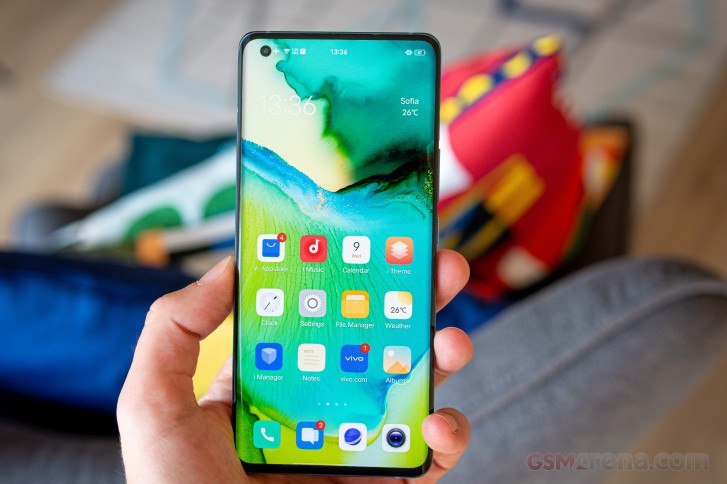
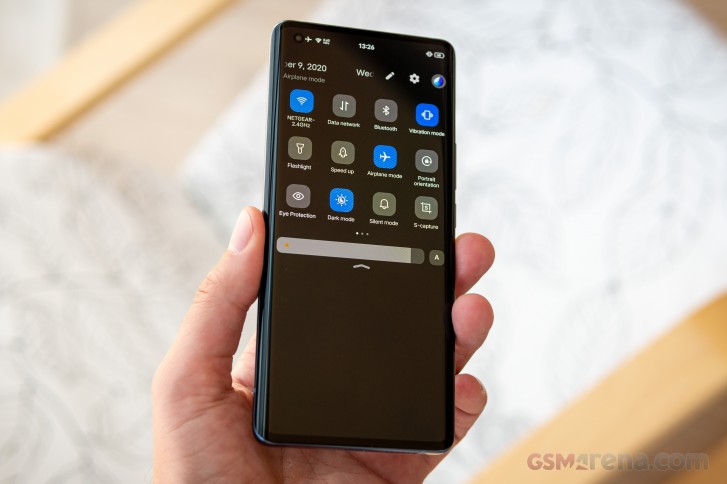
The first thing we noticed is that the new Funtouch has a proper notification shade with quick toggles in it, as opposed to the previous approach with an old iOS-like Control center on the bottom and notifications from the top. And it works like any other notification shade - you pull down from the top and a row of toggles appears, notifications cards below it; pull down again and you get the entire grid of toggles, there is a shortcut to the settings, too.



Notification shade
Funtouch now looks and feels a lot like a clean Android 10 as opposed to the heavily customized old iterations. It has less clutter on the homescreens (the leftmost being a widget one), you get a streamlined App Drawer just like on Android 10, and even the OS navigation is similar.






Funtouch UI
The usual gesture navigation is available with swipes from the sides working as Back. Other navigation options are also available including the swipe from the bottom variety which operates like a nav bar, only with swipes, as well as the classic nav bar itself.



Navigation options and shortcut menu
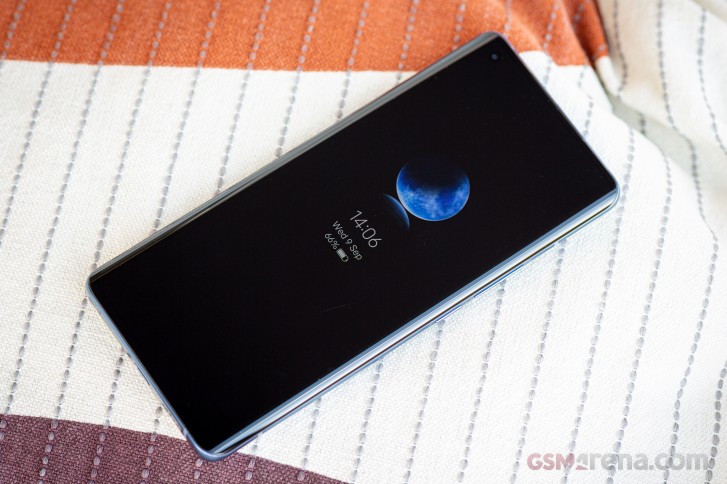
The vivo X50 Pro+ has an always-on display feature, which you can customize to your heart's content. Dark mode for the entire UI is also present.





Dark mode • Dark mode • Dark mode • Always on display • Always on display • Always on display
Biometric security comes in two flavors - an under-display optical fingerprint reader and a camera-only face recognition. Fingerprint recognition works excellently fast, but the sensor area is not as big as on some other phones, so accuracy would depend solely on whether your entire fingertip is on the reader or not.
The facial recognition works extremely fast too, even in pitch darkness, where it lights up the display really quick (a little, not blinding you). While it does require at least one open eye to unlock, it's still a relatively insecure authentication method.




Biometrics and security
There's a bunch of gaming-focused software features baked-in too, operated from within the Ultra Game Mode hub of sorts. That's accessed from the main settings menu or by long pressing the toggle in the notification shade, which also serves a global on/off switch of the features. Game assistant will show a popup, informing you it's got everything optimized and briefing you on current settings - you can disable it after you're tired of seeing it. Game sidebar is where you'll be able to change settings mid-game - handle alerts, screen recording, and the pressure sensitive buttons assignment, among others. You can customize the options in this sidebar as well as disable it completely and only set the things from the Ultra Game Mode Optimization Center.






Gaming settings
Some other Gaming options include Framerate Priority setting if the game supports this. Eagle Eye View also sounds cool with local tone mapping, local contrast settings and forced sharpness option. Finally, 4D Game Vibration is simulated gunshot vibrations in supported games.


Gaming settings
Vivo's Funtouch 10.5 offers a variety of customization options if you are into this thing. There is a dedicated Theme Store with a ton of custom themes, and you can change literally everything - wallpapers and color schemes, icons, fonts, transition effects, among others.




Themes and customizations
The new Funtouch UI is a huge step in the right direction even of some remnants of the past iOS-copy era remain - like the iManager. But it is only a matter of time for vivo to get rid of this one, too.
The entire interface is optimized to work at 120fps, and it is super smooth. We had no issues using Funtouch, in fact, we liked what we experienced a lot. The old chaotic Funtouch is gone in favor of clean and organized one, and we are very happy with that change.
If you opt for the vivo X50 Pro+ though, then you should know it comes with a ton of Chinese apps and without the Play Store app. Getting the Google store is easy from the vivo's own app store, but there will always be traces of Chinese apps and texts across the UI, no matter what. It's not that big of an issue, but an issue, nevertheless.
Performance and benchmarks
The vivo X50 Pro+ is the only one of the high-end trio to employ a flagship chipset and it's the best currently available - Qualcomm's Snapdragon 865 chip. It features Qualcomm's X55 modem that adds full-fledged 5G connectivity.
The Snapdragon 865 has an octa-core processor with a familiar core configuration - 1x2.84 GHz Kryo 585 Gold (Cortex-A77 derivative) & 3x2.42 GHz Kryo 585 Gold (Cortex-A77 derivative) & 4x1.8 GHz Kryo 585 Silver (Cortex-A55 derivative).
The Adreno 650 is part of the Snapdragon 865 and it is among the best GPUs right now.
The X50 Pro+ available with 8GB and 12GB (ours) RAM. The storage options are 128GB and 256GB, while the storage is of the UFS 3.1 kind.
The benchmark scores are easy to predict on any Snapdragon 865-powered smartphone, such as the X50 Pro+. The latest vivo tops the charts and is on par with the best of the best.
GeekBench 5.1 (multi-core)
Higher is better
- vivo X50 Pro+
3411 - OnePlus 8
3399 - OnePlus 8 Pro (120Hz, 1440p)
3374 - Xiaomi Mi 10 Pro 5G
3331 - Xiaomi Mi 10 Ultra
3248 - Huawei P40 Pro+
3203 - Huawei P40 Pro
3197 - Realme X50 Pro
3175 - vivo X50 Pro
1937 - vivo X50
1827
GeekBench 5.1 (single-core)
Higher is better
- vivo X50 Pro+
930 - OnePlus 8
919 - Realme X50 Pro
911 - Xiaomi Mi 10 Pro 5G
905 - OnePlus 8 Pro (120Hz, 1440p)
902 - Xiaomi Mi 10 Ultra
901 - Huawei P40 Pro+
781 - Huawei P40 Pro
780 - vivo X50 Pro
636 - vivo X50
552
The X50 Pro+ is an excellent smartphone for gaming and you can tell by its performance on the GPU tests.
GFX 3.1 Manhattan (onscreen)
Higher is better
- Xiaomi Mi 10 Ultra
78 - Xiaomi Mi 10 Pro 5G
75 - vivo X50 Pro+
74 - Realme X50 Pro
60 - Huawei P40 Pro
52 - Huawei P40 Pro+
52 - OnePlus 8 Pro (120Hz, 1440p)
43 - vivo X50 Pro
31 - vivo X50
24
GFX 3.1 Car scene (onscreen)
Higher is better
- Xiaomi Mi 10 Ultra
46 - OnePlus 8
46 - Realme X50 Pro
45 - vivo X50 Pro+
43 - Xiaomi Mi 10 Pro 5G
42 - Huawei P40 Pro
31 - Huawei P40 Pro+
31 - OnePlus 8 Pro (120Hz, 1440p)
24 - vivo X50 Pro
17 - vivo X50
14
The X50 Pro+ is also one of the highest-scoring Android smartphones on AnTuTu 8.
AnTuTu 8
Higher is better
- Xiaomi Mi 10 Ultra
638497 - vivo X50 Pro+
621433 - Xiaomi Mi 10 Pro 5G
595246 - Realme X50 Pro
592447 - OnePlus 8 Pro (120Hz, 1440p)
573276 - OnePlus 8
564708 - Huawei P40 Pro+
529687 - Huawei P40 Pro
496356 - vivo X50 Pro
323736
You just can't go wrong with a Snapdragon 865 chip and an HRR 1080p screen - this combo pretty much guarantees buttery-smooth gaming performance for the years to come. And that's exactly what the X50 Pro+ is offering - flagship and future-proof performance.
The phone may get hot, and we mean really hot, around its top frame when running benchmarks for prolonged time. We didn't notice any hiccups, but it wasn't pleasant holding a hot metal frame, for sure.
Upgraded quad-camera, no gimbal
The vivo X50 Pro+ features a high-end quad-camera on its back with similar operation logic as the X50 Pro and Huawei P40 Pro, though it lacks the gimbal-stabilization we saw on the regular vivo X50 Pro smartphone.
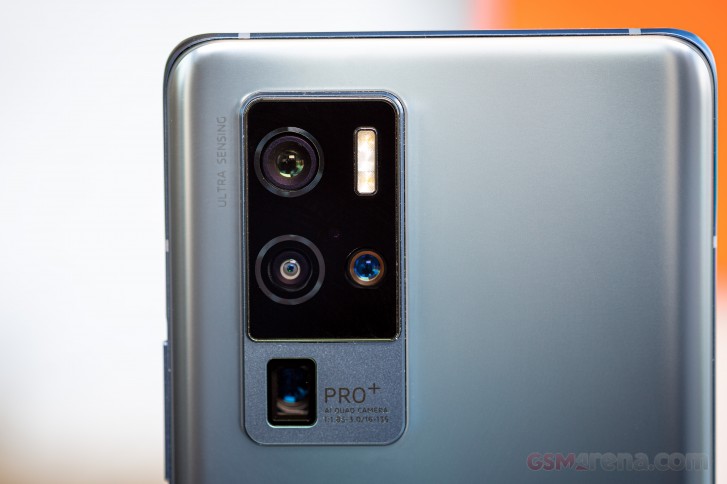
So, the X50 Pro+ features a 50MP primary shooter, a 32MP portrait one (2x zoom), a 13MP telephoto snapper (5x zoom), and a 13MP ultrawide camera. Laser-assisted autofocus is available, optical image stabilization on 1x and 5x snappers, and there is a triple-LED dual-tone flash.
The main camera is probably the most interesting one. It uses a brand-new 50MP Samsung ISOCELL Plus GN1 1/1.31" sensor (S5KGD1) with Tetracell color filter, 1.2µm pitch, and f/1.85 24m lens. Laser-assistance and dual-pixel PDAF are available, naturally. Unlike the X50 Pro, the Pro+ offers traditional OIS for the primary camera.
The ultrawide camera uses a 13MP Samsung ISOCELL Slim (S5K3M5) 1/3.4" sensor with 1.0µm pixels and f/2.2 16mm lens. Thanks to the laser-assisted autofocus, you can also shoot macro photos from as close as 2.5cm away from the subject.
Then comes the Portrait camera with a 32MP Samsung ISOCELL Plus GD1 (S5KGD1) 1/2.8" sensor with Tetracell color filter and f/2.1 50mm lens for 2x optical zoom. There is no OIS here, but PDAF is available, of course.
The fourth and final camera on the back is the 13MP shooter with Samsung ISOCELL S5K3L6 1/3.1" sensor with 1.12µm pixels and periscopic f/3.0 128mm lens for 5x optical zoom (well, 5.33x actually). Optical image stabilization and PDAF are both present.
The selfie shooter uses the same 32MP Samsung ISOCELL Plus GD1 sensor with Tetracell color filter behind f/2.45 24mm wide lens. The focus is fixed.
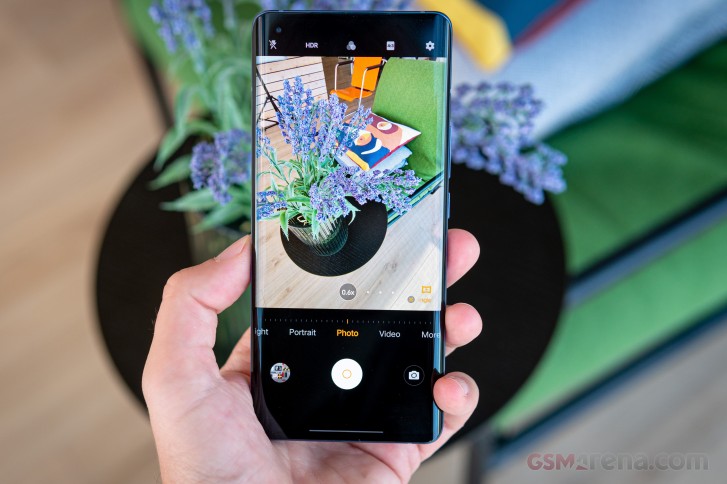
The camera app is the same one we have seen on recent vivos models. You have a zoom selector (0.6x/1x/2x/5x) in the viewfinder and a separate 'lens' selector on the side.






Camera app, settings and modes
The chief modes are switched with side swipes as on most other phones, and the 'More' tab lets you access less common modes. From there, you can also customize the modes you have available in the viewfinder.
Night Mode is available only for the main and ultrawide snappers, and even though it has 2x and 56x toggles as well, those are just digitally zoomed images from the main camera.
There's a Pro mode that lets you tweak photographic parameters yourself. You get to select ISO (50-3200), shutter speed (1/12000s-32s), white balance (presets and a temperature slider), focus distance (no focus peaking), and exposure compensation (-3/+3EV in 1/3EV increments), with easily accessible auto buttons on all and a global 'restore' button to revert everything to auto.
The Pro mode is available on all four cams, you need to use the lens switcher, which in Pro mode offers Super Wide-angle, Medium telephoto, and Telephoto. The 1x switch is not a switch at all, but a zoom slider.




More modes • Pro mode • Pro mode • Supermoon
Photo quality assessment
Let's kick off this chapter with some daylight photos. The pictures we took with the main camera are saved in 4,080 x 3,060 pixels or about 12.5MP and they are flagship worthy. There is more than enough resolved detail, mostly realistic white balance, commendable dynamic range and very low noise levels. And the photos are not over-sharpened, which is a rarity these days.
The algorithm may go for warmer than reality color reproduction sometimes but that's shouldn't be much of an issue - the colors are still pleasantly saturated.












Main camera, 12.5MP
High-resolution option is available, and the dedicated shooting mode snaps photos in full 50MP with the main camera. Since the sensor uses a Tetracell (Quad-Bayer) color filter, the high-res images are upscaled versions of their 12.5MP native output. It's smart upscaling, meaning some interpolation is at play, and the images do look okay, sharp even.
If you downscale the 50MP photos back to 12.5MP you will see they are indeed sharper than the standard pictures, but we can't say they have that much more detail that's going to worth all the hassle and conversions.




Main camera, 50MP
The 13MP ultrawide shots are worthy of their name as they are plenty wide, indeed. The resolved detail is average at best, the colors are a bit washed-out, you can see purple fringing quite often, and noise is present here and there.
The dynamic range is very good on the ultrawide shots and the automatic distortion correction does a good job. The photos will do great for the social networks but are not on par with the best in the class.












Ultrawide camera, 13MP
The ultrawide camera can also snap ultra-macro photos from as close as 2.5cm distance. Those have a sharp center and will capture quite detailed ladybug, or flower, or even tiny text on banknotes. The shots are pretty good, and this ultra-macro mode will do for your occasional macro shots you'd like to put on Instagram and the likes.








Macro photos, 13MP
The 2x zoomed photos from the dedicated portrait camera are saved in 8MP and are excellent across the board. There is very high level of resolved detail, lovely sharpness, spot-on colors, high dynamic range, and low noise.












2x telephoto camera, 8MP
There is a high-res 32MP mode available for this camera and it saves good 32MP images. If you downscaled them to 8MP you will get a bit higher detail at areas of high complexity. We aren't that picky, and we think the whole procedure isn't worth it, but hey - it's there and it works.




2x telephoto camera, 32MP
The portrait camera is, of course, used by the dedicated portrait mode and the shots are equally stunning. The separation is very proficient, and the blur looks brilliant. We would use this mode quite often for sure.




Portraits, 8MP
The 13MP 5x zoomed photos are good, but not quite the best in the class. The detail is enough, sure, but the images are not as sharp as Mi 10 Ultra's or Huawei P40's. Other than that, we are pleased with the color accuracy, the contrast and the dynamic range.












5x telephoto camera, 13MP
Now let's look at some night photos. The main camera snaps great pictures that are rich in detail and with well-preserved colors. Their sharpness and contrast are superb, the noise reduction is really smart leaving just the right level of noise before getting too aggressive and take out some fine detail with it.
The blown highlights are the only imperfection that comes to mind but other than that - these low-light photos are on par with the recent flagships.











Main camera, 12.5MP
The Night Mode is fast and yet proficient enough - it restores the blown highlights, reveals a tiny bit more detail in the shadows, and get rid of the noise we mentioned, though some fine detail goes with it as well.
Note that moving objects such as cars are an enemy to the Night Mode and it may not blur them well.











Main camera, Night Mode, 12.5MP
The 13MP low-light ultrawide photos are okay - the detail is mediocre and smudged at places by the noise reduction, but they keep good contrast and colors. We've seen many worse ultrawide shooters, so while we don't recommend using this one often at night, it may save a good image when the occasion requires it.











Ultrawide camera, 13MP
And if you want that ultrawide night photo to be brighter, then you should use the Night Mode. It does a good job brightening the images and restores most of the blown highlights.










Ultrawide camera, Night Mode, 13MP
The (2x) portrait camera shoots unexpectedly good photos at night. Sure, the detail is far from spectacular and often smeared by the overly aggressive noise reduction, but they retain rather good colors and contrast. This X50 Pro+ is one of the very few phones that continues to uses its 2x tele camera at night, which is nice.
There is no Night Mode for this camera. If you choose 2x in the Night Mode, it will do digital zoom over the man camera.











2x telephoto camera, 8MP
The vivo X50 Pro+ uses its 5x tele camera at night, too. It snaps soft and noisy images, but you can see what's in there and will do for most occasions that require 5x zoom at night. These aren't as good as what we've seen on the Mi 10 Ultra or the P40 Pro, but good enough for the social networks after a couple of tweaks before posting.
Night Mode doesn't work on this camera either, if selected 5x when in Night Mode, the camera will do 5x digital zoom over the main camera.











5x telephoto camera, 13MP
Supermoon mode has been a thing for quite a while already and it is present on the vivo X50 Pro+, too, It triggers once you select 10x zoom and improves the texture of our beautiful Moon. The first two photos are shot at about 10x, and they are pretty impressive.




Supermoon mode 10x • 10x • 30x • 65x
Once you're done with the real-world samples, head over to our Photo compare tool to see how the X50 Pro+ stacks up against other phones.



vivo X50 Pro+ against the vivo X50 Pro and the Xiaomi Mi 10 Ultra in our Photo compare tool
Selfies
The vivo X50 Pro+ uses a 32MP Quad-Bayer sensor and the phone saves them in 32MP, so the photos can't be sharp. They are still rather nice though with good colors and contrast. We would have been just fine with the processed 8MP stills, too.
You can do selfie portraits, too, and there are tons of beatification options. That's not your thing though show good enough though not and the subject separation isn't always that good. The last photo below is a selfie portrait.




Selfies, 32MP
Fight! Vivo X50 Pro+ vs. Xiaomi Mi 10 Ultra
The vivo X50 Pro+ and the Xiaomi Mi 10 Ultra are crème de la crème of the Chinese smartphones right now and we just couldn't miss the opportunity to pit those two against each other. Well, we did and the photos are in.
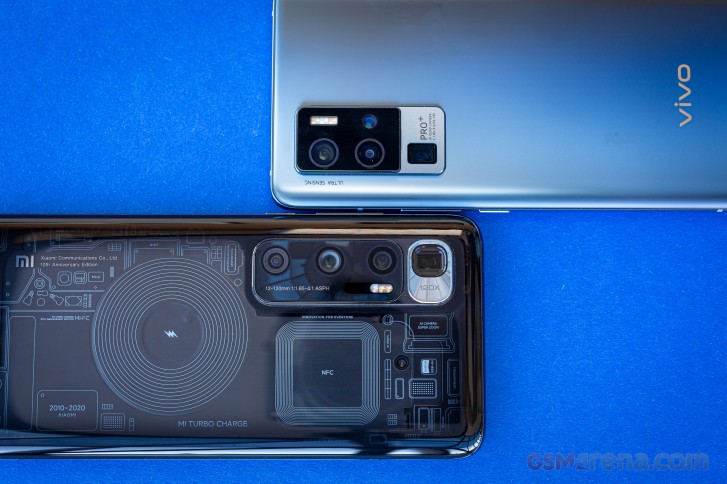
Both phones are very capable shooters in broad daylight, that's for sure. But the Mi 10 Ultra captures more detail and its photos are noticeably sharper. It also shows spot-on white balance, while the vivo goes for a bit warmer hues.




Main camera: vivo X50 Pro+




Main camera: Xiaomi Mi 10 Ultra
Next, we shot a couple of 5x zoomed photos with the long-range tele snappers. And what we observed with the primary cameras fully applies to the zoom snappers, too. While both phones save pretty good 5x photos, the Mi 10 Ultra's are noticeably superior in detail and color accuracy.




5x camera: vivo X50 Pro+




5x camera: Xiaomi Mi 10 Ultra
It's a different picture when the nights falls. The X50 Pro+ often snapped more detailed photos - Xiaomi's noise reduction is more aggressive, and it smears some fine detail, while vivo's more gentle processing leaves more detail and tolerable noise.
But Xiaomi's low-light images are brighter, with better color accuracy and wider dynamic range.




Main camera: vivo X50 Pro+




Main camera: Xiaomi Mi 10 Ultra
When using Night Mode, both phones present bright and detail photos. Xiaomi's images are a bit better at everything though - resolved detail, light, and especially - white balance accuracy.




Night Mode: vivo X50 Pro+




Night Mode: Xiaomi Mi 10 Ultra
Well, there you have it. While both flagships are excellent shooters, Xiaomi's processing turned out the more potent one and often returns more detail and realistic colors.
Video quality assessment
The vivo X50 Pro+ captures video at up to 4320p@30fps with its main camera. The standard 2160p and 1080p resolutions are available, and you can choose between 30fps and 60fps. There is always-on electronic stabilization in addition to the optical one.
All other snappers can do 1080p@30fps and nothing else. If a 4K resolution or 60fps mode is selected, the 2x and 5x modes use the main camera and zoom digitally.
Oddly, if you switch to 8K mode, you can use both the main and the 2x zoom cameras, and yet you can't capture 4K with the zoom snapper.
Audio is captured always stereo at 128kbps. You get to pick between the h.264 and h.265 codecs.
The 4K@30fps clips from the main camera are soft and with very limited dynamic range. The colors are accurate, and the contrast is good enough. They are steadier than the 60fps because of EIS but have a bit narrower field of view.
The 4K@60fps clips are shot without EIS and thus they are sharper and with wider FoV - the picture wasn't cropped and upscaled back to 4K. The 60fps clips are indeed flagship-grade with superb detail, colors, and contrast. They are noise free, too. The dynamic range is mediocre, though.
You can also shoot with the main at night, and if it isn't a pitch-dark scene, the footage will be pretty good.
The native 1080p@30fps videos from all four snappers are splendid - they are sharp with plenty of resolved detail, accurate colors, good dynamic range, and excellent contrast. Oddly, those videos were actually captured with 25fps instead of 30fps, which was unexpected and that's the reason they may seem a bit choppy.
The 1080p@60fps footage from the main camera isn't missing any frames and it's as great as the rest of the 1080p bunch.
You can capture 8K clips at 30fps with the main and the 2x snappers. The footage looks upscaled from lower resolution though, soft and full of Bayer artefacts, and we simply don't recommend using any of the 8K modes.
Electronic stabilization is available for all snappers in all resolutions at 30fps.
Finally, closing this camera section off, here is the vivo X50 Pro+ in our video comparison database.



vivo X50 Pro+ against the vivo X50 Pro and the Xiaomi Mi 10 Ultra in our Video compare tool
Wrap-up
The vivo X50 Pro+ is one very capable flagship with eye-catchy design, one super smooth AMOLED screen, top of the line performance, and, of course, an impressive camera kit and photo quality. Indeed, everything looks quite promising.

That is until the shortcomings start to stack up. The phone is not available outside China, and there are no plans for an international launch. You can import it, of course, but we suspect the die-hard vivo fans are few and far between outside its homeland.
If you get this X50 Pro+, you can install Google Play Store hassle-free. But there will be some Chinese apps and text you won't be able to remove. And then, despite the hefty price, you won't get any increased water resistance, stereo speakers, or even 1080p clips at a steady 30fps frame rate.
We are not sure if the camera experience and the great AMOLED are worth the import hassle as you can get similar specs from other brands that are selling worldwide.
If you live in China, the vivo X50 Pro+ can be a whole other deal for you. Vivo is known for its premium quality across the country and has its loyal fans. And we see no reason you shouldn't get one unless Xiaomi offers you a better deal for a similar phone, say the Mi 10 Ultra.
Alternatives
Indeed, the Xiaomi Mi 10 Ultra is probably the biggest threat to the X50 Pro+. Both phones are currently China exclusives and offer similar specs and snappers. The Mi 10 Ultra isn't as compact and lightweight as the vivo, but it is hands down the best phone for taking photos and videos to date. If the choice boils down to those two - the Mi 10 Ultra is the one you should get if the photo and video quality matter the most.
The Oppo Find X2 Pro is available at even more markets, and it impresses with a higher-res 120Hz AMOLED screen, the same powerful Snapdragon 865 chip, and similar camera arrangement sans the 2x shooter. It cannot do 8K clips (not that it matters), but it has stereo speakers and even faster charging on top of the vivo's specs.
The Huawei P40 Pro+ is yet another limited edition that can be found mostly in China. It beats the rest of the bunch with 10x optical zoom and water-protection (IP68-rated). Just like the Find X2 Pro, the P40 Pro+ also offers a higher resolution 120Hz OLED screen. You can't install Google's package on this one, but you can have one of the best sharpshooters so far. Why not then?
Finally, if you aren't into having the bleeding-edge tech in your pocket, the Xiaomi Mi 10 Pro may as well be your device. It has one very nice design and body, packs a 90Hz 1080p OLED screen, the fastest Snapdragon chip around, and one flagship-worthy camera with 2x and 5x optical zoom options. The Mi 10 Pro is available from many retailers worldwide, at a good price at that.




Xiaomi Mi 10 Ultra • Oppo Find X2 Pro • Huawei P40 Pro+ • Xiaomi Mi 10 Pro 5G
The verdict
It's not that the vivo X50 Pro+ isn't a worthy smartphone, on the contrary. It is doing many things right and has a ton of flagship features that few phones can offer at the same time.
It's just that the whole hassle of importing this phone isn't worth it. There are similar Chinese devices that are easier to find internationally and offer the same or even better specs sheets.
Pros
- Beautiful design, compact body
- Excellent AMOLED screen, very bright, HDR10, 120Hz
- Top-notch performance
- Very good battery life, fast charging
- Powerful and versatile camera with consistently good photos day and night
- Versatile video camera, good video quality
- Smooth Funtouch UI on top of Android 10
Cons
- It's heavily customized for the Chinese market
- No increased water resistance
- No stereo speakers, no 3.5mm jack
- The 4K@30fps is so-so, 1080@30fps is 1080p@25fps
0 Response to "vivo X50 Pro+ review"
Post a Comment